Monday, July 22, 2024

She Left This World a Better Place

 Read at my mother's memorial service, January 20, 2024. 

As the perceived “sickly” child of a mother who was herself sheltered by an overly-protective mother, I had a close but difficult relationship with my mom. Everyone who knew us had some sense of this. I’m afraid I pushed back at her the way she spent much of her life pushing back at my grandmother. My grandmother and my mother lost a baby brother/uncle New Year’s 1943 and a husband/father July 4th, 1944. When my mother was 8, two empty seats haunted the family table, and two holidays became reminders of sudden loss. I was often impatient with my mother’s perpetual worries and, well, mothering. The past couple of years of her decline, I’ve had time to think about it all.

What she managed was extraordinary. For all the protectiveness she experienced throughout her life, my mom cut her own path. My earliest memories of her—during her relatively brief stay-at-home period—were those of a woman who was not only maintaining a household but also always exploring her own creative interests. I believe during my older brother James’s early childhood she’d painted paintings of and created children’s books around the characters Franny Ant and her friend Danny. I can see her in our living room on Baylor Drive painting, doing needlepoint, and writing—diaries and stories and letters, sometimes in protest to politicians and television networks. She sang in local choirs, and she was involved in her churches and in local political organizing. When I turned 9, she began to work for Mutual Girl’s Club at the Concern Center across town and across the tracks from our home. 

Despite (or perhaps in part because of) being raised in the South with Black housekeepers, Mom was not only pro-Civil Rights, but she integrated my childhood. I remember spending afternoons with the girls and women down at the Concern Center’s Mutual Girl’s Club. I think of Mom as always encouraging others to pursue their interests, so it’s no surprise that I found myself doing a magic show for those young women and, much to my embarrassment, choking on the big finale.

Some of the best friends Mom ever had were the group of women she began to spend her time with at Mutual, including her lifelong friend Kathy Hall. This train of thought, though, leads me to think of the club art director, Geraldine Townsend. She was a coach and confidant to my mom during that time after my parents’ divorce. I will forever associate that early 70s celebration of Soul and Black Liberation with the women of Mutual, in particular her friend Geraldine.

Ten-year-old me teased my mother about her Stylistics, Diana Ross, and Aretha Franklin records. I believe I referred to them as “old people music.” Of course, as I grew older, a concept of soul rooted in that music became central to my own sense of what mattered most—a vision that grappled with race and relationships while hanging onto hope for a better world.

In many ways, Mom’s life was hard, and our relationship took some hard knocks. But, far beyond anything I can tally, I am thankful to her: for all her support and for passing along such an open-ended vision of community. Mom’s several marriages led to a larger and larger sense of family. She cherished the accomplishments of those around her, and she made much of any writing I ever did. She even framed emails and hung them on her walls. She always asked after everyone in our family, and she was eager to hear about each of my friends, even if she’d never met them. If you were my friend, Mom was a fan.

For all these reasons and more, I want to thank Mom for being who she was—in all her sometimes meddlesome, sometimes infuriating, but also brilliant, caring and loving, glory. Mom was a beautiful person, in every sense, and the world’s a better place for having her here with us. Some piece of that beauty, I feel certain, is carried forward by every person in this room.


Statement made by Bartlesville's Westside Community Center.  

Honoring the Life and Legacy of Mary Robinson 🕊️
It is with heavy hearts that we share the news of the passing of Mary Robinson. Mary was more than just a dedicated employee at the Westside Community Center (WCC); she was a beacon of hope and a tireless advocate for our youth.
For over 70 years, WCC has been a pillar in our community, and Mary played an instrumental role in our mission, especially in her later years under the leadership of Executive Director Morris McCorvey. Her unwavering dedication, boundless love, and selfless contributions have left a lasting mark on all of us.
Mary’s journey of service began long before her time at WCC. She worked passionately for the Mutual Girl's Club and the Bartlesville area schools, where she dedicated herself to empowering young minds. Her efforts have not only enriched the Westside Community Center but have also strengthened our entire community. Mary’s legacy is one of compassion, resilience, and an enduring spirit that will continue to inspire us all.
We remember Mary not only for her hard work and dedication but also for the warmth, kindness, and genuine care she extended to everyone she met. She was truly loved, valued, and appreciated by all who had the privilege of knowing her.
As we honor Mary’s memory, we are reminded of the profound impact one person can have on a community. Her spirit will live on through the programs she was part of, the lives she touched, and the love she spread.
Please join us in celebrating Mary Robinson’s incredible life and legacy. Share your memories, stories, and tributes in the comments below. Let’s come together to honor a remarkable woman who made our community a better place for all.
Rest in peace, Mary. Your legacy will forever remain in our hearts. 💖


Thank you to Bartlesville's Westside Community Center's Morris McCorvey and the current executive director Shavon Robles for their beautiful statements on the day of Mom's service., and thank you to Donnie Mooreland for the Juneteenth photos.

Mom's obituary with a link to donate to Westside Community Center: https://www.honoringmemoriesbartlesville.com/obituaries/mary-robinson

A direct link to Bartlesville's Westside Community Center

Juneteenth 2024, Westside Community Center, photo by Donnie Mooreland


Tuesday, June 25, 2024

“Away from Babylon: The Irresistible Revolution of Lizzie No’s ‘Halfsie’s'"

About halfway through Lizzie No’s opening track (the title cut), a wall of sound begins to echo a haunting three-note refrain. Soon the sound erupts into explosions blossoming out of previous explosions, and then it goes quiet again, then louder and quieter again. This movement between the vulnerable and the impenetrable calls to mind everything from the Velvet Underground’s “Heroin” to Nirvana’s “Smells Like Teen Spirit” to Otis Redding’s “Try A Little Tenderness,” without any of that last example’s hopeful suggestions. That's as it should be. The dynamics of this opener forecast the concerns of an enormous record.

And with huge rockers like the snarling “Lagunita” to launch the middle third and the foot-to-the-floor “Getaway Car” before the final song’s quiet coda, that big sound outlines the scope of rock itself—probing past seemingly unendurable pain and dreaming past received and “reasonable” limits. Lizzie No wants it all, and over the course of this album, she suggests what she wants is within her grasp, or at least the grasp of the album’s persona/avatar, the she/her/they/them Miss Freedomland.

No has explained that she wanted to use the concept of a videogame and an avatar to get away from the way fans or media read the personal into women’s work. At least that's how I interpreted her explanation. As a writer who has often focused on women, that’s certainly what I’ve seen, the tendency magnified as a few women have become dominant forces in the industry. It is hard to imagine people making the assumptions about real-life relationships that are made with Taylor Swift and Beyonce if the subject were any of The Beatles or Bob Dylan, and I highly doubt Post Malone or Morgan Wallen get that treatment either. Even if they do, No's work-around works well, allowing her to write extraordinarily personal music, whatever it has to do with the artist’s real life.

The specifics in the lyrics and the music matter. I love the “hollow shell” of the moon in “Sleeping in the Next Room” as well as the shimmering vocal blend with Kate Victor and Sadie Dupuis. I love how “Lagunita” has all the fury of the best post punk (tip of the hat to guitarist Graham Richman and drummer Fred Eltringham throughout) as well as the way No hangs onto the taste of the “calf in the gelatin.”

 Lyric Video for "Lagunita"

No’s website quotes Toni Cade Bambara saying, “The role of the artist is to make revolution irresistible.” That’s just what No does repeatedly here, tearing away all hobbling ties on “The Heartbreak Store,” “Done,” “Annie Oakley,” “Shield and Sword,” and “Mourning Dove Waltz.” To underscore the irresistible qualities, that last sounds like a Carol King record about a mother accepting the necessary loss of her children to go and live their own lives. Mourning Dove Waltz video

Official Video for "The Heartbreak Store"

No first really hooked me with “Deadbeat,” a song about a woman recognizing her father’s worst qualities in herself. In at least one interview, No has talked about this as a flip on the typical country music script where the male singer’s hopeless qualities are romanticized. That said, what hooked me about the song wasn’t a sense of parody. It was the truth of it. I have known and loved people who could sing this straight, and I am this person more than I would like to admit. The fact that No goes there—with a knowing and even funny sense of irony—makes it work as well as any such song by a man, only deepened by that gender reversal. And there are a few archetypical country songs on this record, but this one doubles down on a strength of the genre—its hard focus on a clever and engaging lyric, shimmering guitar arpeggios and long-bowed strings simply underscoring the sad truth of it all.

The album ends with “Babylon,” a modest little folk song that defines the promised land based on all that’s being left behind—thieves and killers, fears of pain, the threats of shame, and the devil itself, in all its forms. The guitar roll that’s propelled this vision forward keeps going after the words end, pushing onward to what might be, what could be, and not only asking us but making us want to follow its lead. 

Lizzie No's Website

Monday, April 15, 2024

So You Can Live In A Better World: The New One from Sarah Langan


The title of Sarah Langan’s A Better World appropriately comes from one of the many difficult conversations that take place between protagonist Linda Farmer and her husband, son, and daughter. She’s a thoughtful parent with a difficult past, and she reaches at the absolute limits of her understanding to communicate with the others in her family. In her daughter Josie’s uncharacteristically clean bedroom, Linda struggles to find out what’s going on with her child, and Josie says, “You don’t see me.”

This conversation ends with some ugly “Fuck yous!”

But it leads to the truth. Linda later admits, “When you’re living a thing sometimes you’re too close to know.”

And mother and daughter—eventually as well as son/brother and husband/father— all get to the truth. The truth doesn’t set them free, but it brings them closer together, and in that position, they are able to work their way to hope.

Yes, A Better World is a first-rate dystopian thriller. The speculative world feels right. Rather than the jack-booted thuggery of 20th Century fascism, we have decadent capitalism surviving far past its viability. A world where democracy exists as a series of ragtag fiefdoms that, at their best, pale in comparison to the company towns created by individual corporate autocrats.

In fact, the world of A Better World feels almost exactly like the world we live in now, its satire rooted in our own excesses. The ActHollow organizing committee that stands apart from the town and boldly runs town society as well as crucial infrastructure would make familiar television—The Real Housewives of Plymouth Valley. The absurdity of the town mascot is, in the best magic realist sense, believably ironic—a genetically engineered low-carbon-footprint, no-hormone-fattening bird called the Caladrius, after the mythical Roman beast that eats sickness and restores health to humanity.

Except think instead of Gabriel Garcia Marquez’s “A Very Old Man with Enormous Wings,” the story of a diseased, disappointing creature that no one can believe is an angel. Langan’s Caladrius is a fat, dirty, and uncoordinated chicken, a little like a blind, arthritic, and infertile transgenic pig. Langan’s world has trillionaires while most live in poverty; our world anticipates the first trillionaire in a decade while 5 billion people have become poorer since Langan’s last book.

In that book, Good Neighbors, Langan distinguished herself by not only writing riveting speculative fiction, but by focusing on carefully nuanced families in the foreground, getting at class bias in a society that pretends it doesn’t exist. In Langan’s latest argument, the family dynamics make a globally urgent and necessary case. It’s no stretch to say A Better World suggests the fate of the planet depends on the hard work we do in our most intimate and crucial relationships. The level of truth we hope to find in those places holds the key.

And if we’re honest, we know this is the key we’re looking for in even the most casual conversations in America 2024.

Linda Farmer admits it’s hard to see the truth of the big picture when you are living through it, but her story shows us why we must try. For that reason, and many more (including the pleasure I had tearing through this book despite a very rough chapter in my own personal history), A Better World makes a case for the value of speculative fiction by answering the pain of the real world we live in today with uncommon heart and soul. Sometime soon, we need to start talking about what’s happening around us with the same kind of unbridled honesty Josie Farmer demands from her mother. A Better World can help. At the very least (and there's so much more), it does help.

Sarah Langan reads at Village Well books, courtesy Chris L. Terry

Reviews of Langan's previous books: 


Sunday, March 31, 2024

Kansas City Fights for Home: From Rural Grit to RecordBar to City Hall and Back to the Brick

The Living Breathing Folk Song Last Monday
 

"If I had to start my business over, I wouldn't do it. There's a big difference between building a business and making a home”—Peregrine Honig, owner of Birdie’s, at the recordBar “Know Show”

Honig at RecordBar Know Show

In a March 4th social media post, Kansas City’s great guitarist/vocalist/support player and all-around instigator Cody Wyoming, wrote these words:

 "Here’s the big downer.

 “I am astonished at how little value is placed on what is essentially my life’s work. Being a local musician, I am not unaccustomed to being undervalued. I’m no stranger to dismissal and disrespect. But even in this day and age, when Live, local music, is already an endangered species; I find myself aghast at how lowly and dismissively that the majority of the population views my 'life’s work' not mine specifically. All of it. Everybody who does what I do. People have no regard for what we do. We are not 'essential.' We are not important. And we are not worthy of consideration."

Kadesh Flow at Know Show

 
In the entire post, but particularly in these words, Cody has captured where we are at this point--in our world, in our country, in our everyday life. What matters about life is not valued. It doesn't matter against the need to make the next big buck, particularly as the capitalist system falls apart.

 You know, there was a time (1776) when “Father of Capitalism” Adam Smith saw the potential of the system to liberate organized workers. Smith before Marx made it clear the workers had to collectivize because the owners (Masters, as he called them) would always push wages down. Of course, the first country based on this system immediately employed slavery for 80 years until the industrial economy won out. Then, it fought unions the whole way. Now that our technology has reached a point where the value of labor itself is trending toward zero, the owners are organizing in new ways, with speculations like that so well documented by John Sherman’s ‘Royal Request." 

The Filmmakers, Wednesday

I have included that video and seven others documenting the activity this week here: "John Sherman's 'Royal' Request"

This is why Rural Grit, the Record Bar, and a host of musicians--too numerous and from such diverse genres I cannot begin to try to sum it all up--are joining forces with KC Tenants, the Missouri Workers Center, Standup KC, and other groups fighting for basic rights and opposing the ridiculous lies currently being spewed by the billionaire class to turn downtown KC into nothing more than a series of interconnected amusement parks.


What's been happening at the The Brick the past few weeks has been even more amazing than what happens at the Brick all the time anyway. People are coming together to maintain that scrap of humanity that exists between the 1400 block of Grand and McGee and 20th Street, a place we have been proud of as the Crossroads Arts District, even the ground where Hemingway once pledged he learned most of what he needed to learn writing for the Kansas City Star. 

Nora Bell with her own, great "Vote No" song

The world is trying to move on to a place where billionaires can make their last cash grab before the system entirely collapses and the average person has no say in the future. From Artificial Intelligence to the richest of the rich planning their escape to Mars, we do realize this is the juncture in front of us, don't we? We've seen this coming a long time.

 Are we ready to fight for our quality of life?

 People may think this is simply a stadium question, but I would argue it's much more than that.

 It's about whether we believe people matter. As Cody says, "our life's work" is at stake.


That’s all of us who don’t have the money to push others around. That’s most of us in a world where a January Oxfam report stated, since 2020, “The world’s five richest men have more than doubled their fortunes…while the wealth of the poorest 60 per cent - almost five billion people - has fallen.”

 It’s not hard to see where our real interests lie—with each other, with our artists, our fellow tenants, and our fellow workers who can be outspent but who have numbers on our side.

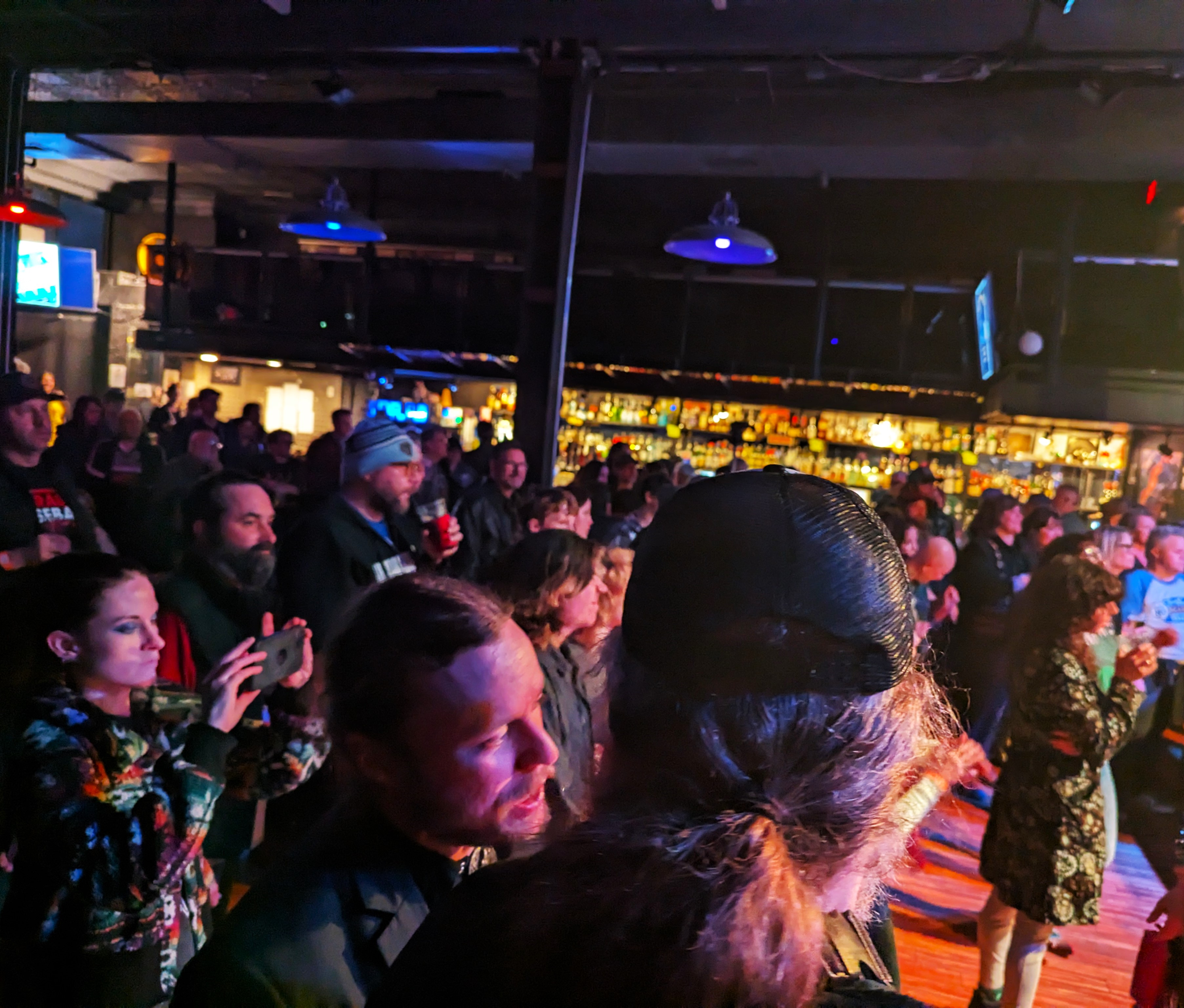
 And we have our art. The Rural Grit Happy Hour moved its party to Kansas City’s premier music venue recordBar on Wednesday night and packed the house with four hours of short sets of everything from Indian instrumental music to hip hop to folk to rock to hardcore punk.  

Steddy P Rocks the "Hell No" Show

Everyone got off on each other’s music and perspective. I’ve never seen this city come together the way it did that night.

 And something even bigger is happening tomorrow, April 1st.

 In the words of the organizers:

 RALLY TO SAVE EAST CROSSROADS!!

 EVERYONE BRING YOUR VOICES AND YOUR SIGNS!!

 MUSICIANS OF ALL SKILL LEVELS AND AGES: BRING YOUR INSTRUMENTS!!

 ALL SUPPORTERS, ADVOCATES, GROUPS, ALLIES, AND FRIENDS!!

 Rural Grit announces a community rally for all Jackson County residents and friends of East Crossroads to tell voters to VOTE NO! ON APRIL 2!!

 Assemble by 4:00 PM on Apr. 1st at Ilus Davis Park in front of City Hall. Musicians will be singing and playing and encouraging our entire community to sing with us.

 At 4:55 P.M. our Rural Grit All-Stars will lead us in singing and chanting our fight song: "Keep Singing In The Crossroads"

Royals go home!!

Keep singing in the Crossroads!

Royals go home!!

 Following the rally we will march to The Brick, 1727 McGee, for the final Rural Grit Happy Hour VOTE NO! SHOW.

 VOTE NO! ON APRIL 2ND!

This is no small thing. In some ways, it's everything. That's what I know when I see the best of us fighting together. I hope to see you tomorrow. DA