
A Fully Formed Picture: Kelly Hunt's "Ozark Symphony"
https://youtu.be/4ZVaX-ij_xQ?si=0bloSIHWAivKGg34
A Fully Formed Picture: Kelly Hunt's "Ozark Symphony"
https://youtu.be/4ZVaX-ij_xQ?si=0bloSIHWAivKGg34

“You can say
what you want about any of those folks, if it weren’t for them, I wouldn’t be
here.”
After the
2021 Land of Hope and Dreams conference celebrating Dave Marsh’s work and ideas,
someone complained about someone else’s performance. Marsh made the above comment in part to defend an old friend. He also wanted us to
recognize the debt he owed.
On the eve
of publishing the new Dave Marsh anthology Kick Out the Jams, I want to
say the same about Marsh. I can put it even more forcefully. If you are not a
member of my extended family, you know who I am because of him.
Most people
Dave Marsh influenced wouldn’t put it quite that absolutely, but I bet many
would have to think about it. That’s why the Land of Hope and Dreams conference
came together relatively easily, and that’s why this new book came out of this
discussion.
On Marsh’s
70th birthday, half a dozen of his friends began to discuss how to
celebrate such a significant career in our own life stories. He had not only kept
pushing us to think over the past four or five decades, but he was also how
most involved found one another.
A member of the
group talking about all this, University of Wisconsin African American Studies
professor Craig Werner, had a similar conference upon his retirement from the
school. I wrote about that one here: https://takeemastheycome.blogspot.com/2019/08/the-only-light-we-see-craig-werner-and.html
Werner and
Marsh are both community builders, and we knew a celebration of Marsh’s
work would tell a unique story of people and ideas set in motion around popular
music.
About eight
of us started meeting regularly on Zoom and, within a year, pulled together
three weeks of activities that featured five spotlight conversations and twelve
different panels featuring seventy different participants. Each had something
to say about what set this work apart and its implications for the world we
live in today. You can still find the whole conference with panel descriptions
and bios here: https://landofhopeanddreams.co/
There’s also
a YouTube page which houses the video links: https://www.youtube.com/@landofhopeanddreamsatribut7061
The idea of a sequel to Marsh’s Fortunate Son anthology, published in 1985, grew alongside this project. Fortunate Son is a terrific book, but it covers a little over a decade in a career that has spanned five. Since leaving Rolling Stone in 1983, Marsh not only wrote or edited a couple of dozen books, each an important and unique contribution in its own way, but continued working as a journalist for Rolling Stone’s wonderful spin-off Record, and a great magazine called Musician, as well as everything from the Village Voice to TV Guide to Alexander Cockburn’s political newsletter Counterpunch. Most significantly, throughout Marsh’s post-Rolling Stone career, he collaborated with music and sports journalist Lee Ballinger, music industry insider Wendy Smith, my co-editor on this book Daniel Wolff, and editor and agent Sandy Choron (as well as everyone else they knew) to produce a rock and politics newsletter designed to eliminate the divisions between insiders and outsiders in the record industry, Rock & Roll Confidential (later Rock & Rap Confidential) or RRC.
.jpg) |
| The first Rock & Rap Confidential |
The history of Dave Marsh’s writing after the Rolling Stone era is a history of making connections between artists, music industry workers, and fans around our common struggles. RRC brilliantly reflected, clarified, and helped facilitate what was happening in the 80s when even mainstream musicians were regularly making statements (and making benefit records and throwing huge events) around issues like hunger and homelessness, basic human rights, and neocolonial human rights abuses in Central America, Africa, and throughout the world.
One thing
RRC did so well was to always bring these struggles home.
In 1987, I
found my voice writing for RRC by connecting the antiapartheid movement to the
racial divisions on the airwaves and around my college campus in Oklahoma.
But that
wasn’t the start of Marsh’s influence on my life.
It started back
when I turned teenager reading his work in Rolling Stone. My brother first
drew my attention to Marsh’s name, along with Greil Marcus, Mikal Gilmore, Cameron
Crowe, and other stand-out rock critics of that time.
They all
influenced me, but Marsh in a singular way. When I seemed to be the only person
in the world who thought a sophomore album was better than the debut, he would
be the one voice that agreed. When I heard a hitch in a vocal or a four-note
guitar riff that defined the impact of a performance, Marsh tended to be the
one who pointed it out. Even and perhaps especially when we disagreed, Marsh’s
work struck so deep it taught me something else. His writing repeatedly
reinforced the idea that I didn’t have to agree with what everyone else was
saying. What I really needed to do was speak honestly my own perspective
whenever it was important to do so.
That may
seem obvious, but it wasn’t the message this 13-year-old was receiving much elsewhere
in the world. It was liberating, and, later, when I was trying to pick a major
in college, the idea of Dave Marsh flashed through my mind as I declared
English. I didn’t know anything of his short-lived career at Wayne State; but
it was an intuitive leap that paid off.
About three
years later, I met him at my school. A friend of mine ran the speaker’s
committee, and I saw a Dave Marsh flier on her desk.
I said, “Get
him!”
She said, “Join my committee and fight for it.”
.jpg) |
| Marsh on the back cover of Fortunate Son |
I did, and
that whole experience—helping to host the event, a packed house in our campus little
theater—taught me more about myself than I ever would have guessed. We all had
great discussions, and, for my part, he left me with a piece of paper that had
his home phone number and address, as well as the names of imprisoned voting
rights activist Spiver Gordon and imprisoned American Indian Movement activist Leonard
Peltier. My Peltier cover story for the Kansas City alternative press The Pitch
would help me land a second job writing for its chief competitor, The New
Times.
But all that work started after I sent Marsh my term paper for the semester he visited campus. He was very complimentary and invited me to help with RRC, acknowledging that he had little to pay and comparing the offer to Tom Sawyer asking friends to help him whitewash his fence.
The line I
remember verbatim guided my transition and the rest of my writing career: “What
in hell does the last paragraph on page 11 mean that couldn’t have been said
with half the words and none of the academic gobbledygook?”
“Nothing”
was my answer, and that lit a fire in me. I started writing reviews of every record I was listening to that Marsh and Ballinger might use
in the newsletter. Most of it didn’t get in, but I kept plugging away.
Eventually, I became a regular.
I also began
to pull together articles for an RRC-like newsletter I was calling The Red
Dirt Runner, but that never got past an initial layout.
In October that year, I moved to Kansas City and started a newsletter called A Sign of the Times with other RRC subscribers in the area. We printed our local take on RRC for about three years, 2000 copies at a time distributed everywhere around town.
.jpg) |
| Our first issue, every word that fit |
The whole Sign
of the Times bunch would collaborate with folks like Dirt Cheap Recycled Sounds
owner Anne Winter, Carla Duggar and Katrina Coker of the ACLU, and Hollywood at
Home video store owner Richard Rostenberg to form The Greater Kansas City
Coalition Against Censorship, later called the Kansas City Free Speech
Coalition. Marsh would visit and speak as an individual and as part of a panel
at our first annual week-long celebration of free speech, Culture Under Fire, a
tradition that lasted about a decade.
Because of
the networks I inherited by working with RRC, I wrote music-related editorial columns
for the Pitch, the New Times, the Note, and other area
papers. Among other issues, I wrote about music censorship, racial segregation
in our entertainment districts, and curfew ordinances aimed at east side youth.
One reason
Marsh made so much sense to me was that he saw no division between journalism
and activism. I could address questions of objectivity and professionalism by
finding the right angle and stance to get the job done without compromising my
ethics.
Though I was
primarily a journalist, I helped Ron Casanova incorporate and raise awareness
about his organization, the Kansas City Missouri Union of the Homeless. Together
with the free speech coalition, we held a national Break the Blackout Summit to
strategize practical solidarity among poor people’s organizations. This would
eventually lead me to ongoing work with the Poor People’s Economic Human Rights
Campaign. Marsh was there, one way or another, each step of the way.
After the
death of Dave Marsh and Barbara Carr’s younger daughter Kristen at 21, we all began to
focus more on health care issues. We took what we learned and held panels on
musician health care at Folk Alliance and SXSW. Locally, we founded the Kansas
City Music Alliance to find local ways to work on such issues. Thankfully, before
long, Abigail Henderson would build the Midwest Music Foundation which did such
things far better than we ever could have managed, but the Music Alliance is a
precious memory, as was my time with the hip hop collective Flavorpak (which continues
to this day), all informed by the idea that there’s an inherent good in
gathering together to tackle the problems we all face.
I could go
on, but I won’t. What’s that great line from Tillie Olsen’s “I Stand Here Ironing”?
“I will never total it all.”
In Marsh’s
first anthology, he talked about how music opened the world to him, making him
question everything he knew that held him back from the vision in music. “Looking
over my shoulder,” he wrote, “seeing the consequences to my life had I not
begun questioning not just the racism but all of the other presumptions that
ruled our lives, I know for certain how and how much I got over….What was left
for me was a raging passion to explain things in the hope that others would not
be trapped and to keep the way clear so that others from the trashy outskirts
of barbarous America still had a place to stand—if not in the culture at large,
at least in rock and roll.”
Dave Marsh has always done that for me. He helped me find a place to stand and a way to work. That
foundation contributed to everything else I have done.
This new anthology illustrates just how far Marsh carried that mission once he stepped
away from Rolling Stone. In these pages, by looking closely at the
realities of the music industry and the contradictory ideas it cultivates, he
tackles common myths that keep musicians and fans trapped in a world where
nothing can change. Among other stands, Marsh takes on Ticketmaster side by
side with Pearl Jam. fights against the death penalty watching a friend’s
execution, and frames the legacy of musicians like my Stillwater brother Jimmy
LaFave who lost his own fight to the very same rare cancer that took Marsh’s daughter.
I love the
fact that the MC5 song “Kick Out the Jams” which gave us our title, demands
that we keep the music playing as key to overcoming all that we’re up against.
In music, there’s a certainty that we can imagine a better world. Dave Marsh’s
writing never quits pushing that dream toward a working reality.
On August 15th,
to illustrate that point, writers, artists, musicians, and activists will gather
at the Warwick Theatre at 3927 Main for a book launch party. Doors will be
open at 5:30, and at 7:00 at least a dozen local musicians, artists, writers,
and activists will take the stage to read from the book and/or make statements about
the vision I have outlined above. In this way, here and in other cities where
we are planning similar events, we plan to build on Marsh’s ideas in the only
way they can truly be addressed, through community.
.jpg)
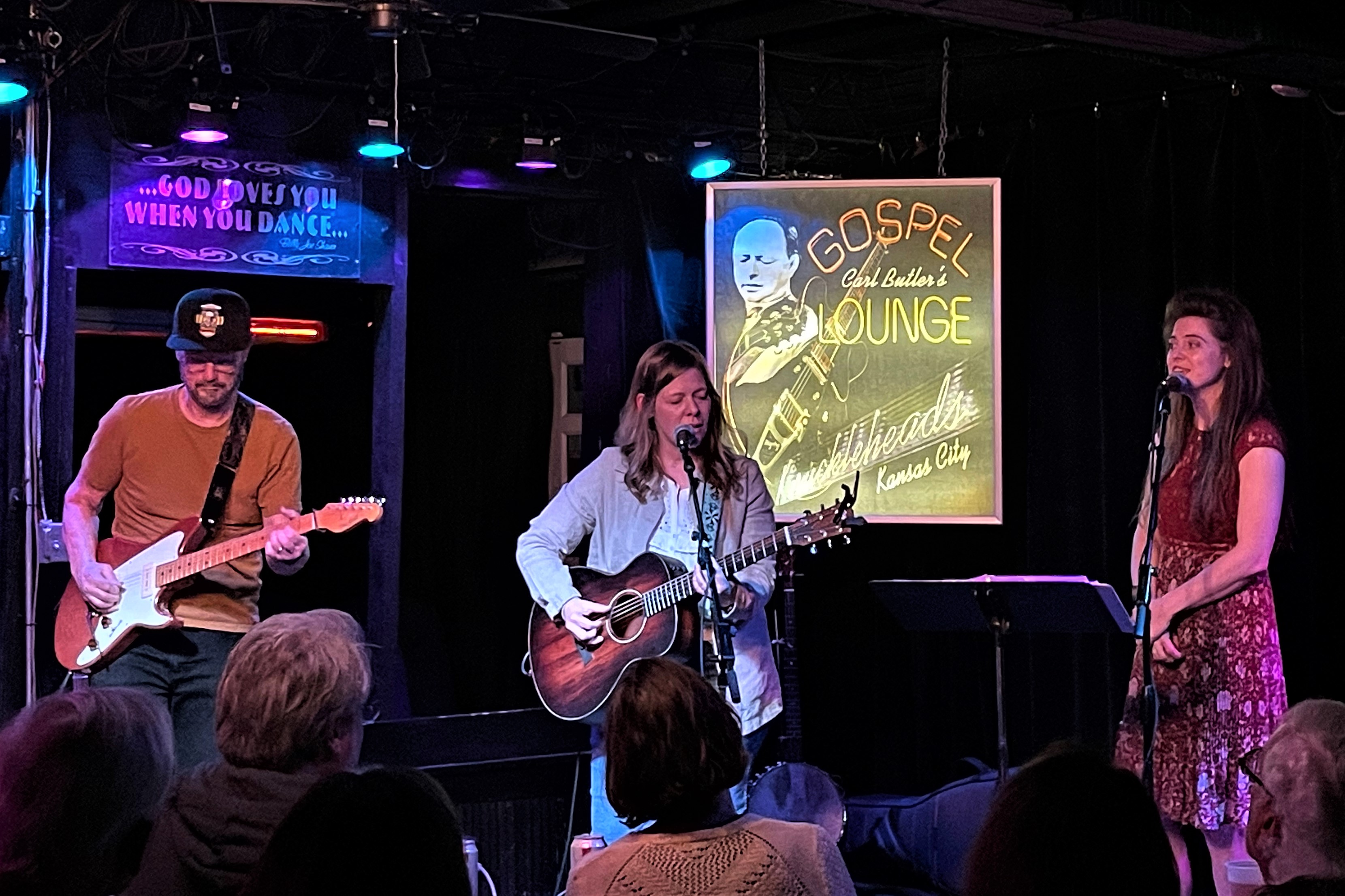 |
| Flynn, Swenson, Hunt (photo by Shelli Baldwin) |
During her opening set, she talked of writing songs, picking her banjo on the green caboose that sits at the end of Main Street in her hometown of Weston, Missouri. From this port on the Missouri River, where the Santa Fe Trail and the Oregon Trail both began, it’s not only easy to imagine this young woman feeling all the yearning and fear in that history, but also almost impossible not to hear her wrenching hope and loss out of each word she sings.
She lay a solid foundation for Swenson, who came onstage and met us right where we’ve all been living these last three years. Accompanied by understated, precise guitar (and a little mandolin) from John Flynn, Swenson joined us in the darkest part of the night with her song “Brother,” a celebration of what just might matter most, that we’re there for each other when dawn seems so far away. It’s a beautiful meditation on that need, one that brings out the full swing of Swenson’s vocals, from an alto drawl someplace close to Lucinda William’s gravel roads to someplace not only high and lonesome but delicate and bright, a light in the darkness.
After, she said, “That’s the song my daughter calls my imaginary brother song.” And the room laughed, as we did many times that night. Swenson told stories of her kids and her sister’s kids. Then there was her grandfather, celebrated on the song, “My Little Girl.” That’s a song about a time, after her grandmother died, that little Sara called up her grandfather and asked if she could spend the night with him. She reveled in his memory, explaining how he liked to share information he’d gathered from newspaper clippings, always pointing at the family with such a decisive move she swore they could hear his index finger pop.
Adding to the familial feel of the set, Hunt joined Swenson most of the time, standing to her left while Flynn played on the right. Like the “imaginary brother” her daughter calls her on, Swenson managed to weave a family not only out of characters fictional and real in her songs, but out of the circle of friends, family, and fans gathered in Carl Butler’s Gospel Lounge in the back of Knuckleheads, already the most intimate room in the venue.
She did this with a hard focused, yet playful progression of ideas. The imaginary brother gave way to the “Messy Love” where two partners never quite give the other what he or she wants but manage to have what they need. Then she defined the whole of it with “Welcome to the Family,” a song Swenson smiled and introduced as, “We’re all just doing the best we can.”
She sang of one of her first glimpses of parenthood, the rollicking “O, My Babies,” inspired by her sister’s children. She followed that with the lingering contentment of “Night Sounds,” a song she punctuated with the end comment, “Those were the kind of night sounds you heard lying out on your deck in Hyde Park, before kids,” then hilariously impersonated children finding every reason on earth not to settle down and go to sleep.
Though she had us all laughing, she wasn’t done with the quiet. Hunt and Flynn went and sat down. Swenson said, “I’m going to try something.” She then offered a solo, acoustic version of the title track of her 2010 album, “All Things Big and Small,” a simple lyric, part prayer and part lullaby. “Hold these seconds near your heart like a locket.” Though we could hear the bands over in the Knuckleheads garage and out on the roadhouse deck, we leaned in and did just that.
Hunt then joined Swenson for a still spare—their voices and Swenson’s guitar—version of “Big Pretty City” from her 2014 album Runway Lights. Before she began singing, she explained she wrote it as a celebration of London. Without knowing that, it’s all too evident that this mandala-like work is a rich portrait of the ephemeral’s movement through that which seems eternal. The turning lights of that song brilliantly set up perhaps her most famous song, “Time to Go” (featured on the television show The Practice) and the close of this warm, familial vision, “Vistas,” a song about the infinite possibilities of a single relationship.
Introducing, “Time to Go,” Swenson laughed and said, “But don’t go yet. We’re not done.” The set ended with a surprise, the greatest song by the greatest songwriter lost to COVID. All three were on stage together for a gorgeous rendition of John Prine’s “Angel from Montgomery,” and joy and pain could not have been more perfectly wedded. Swenson, Hunt, and Flynn gave flight to that imaginary (but all too real) old woman in the song and gave everyone in the room a reminder of what community can be even in a portrait of its absence.
https://saraswenson.com/ https://www.kellyhuntmusic.com/
 |
Earlier blog about Swenson:
https://takeemastheycome.blogspot.com/2011/11/sara-swenson-pearl-snaps-and-soft-touch.html
 |
| Iris DeMent and Ana Egge |
I’ve been sitting with it for a week. One morning I wake up, and “The Sacred Now” jangles in my head telling me that’s the heart of the show. The next morning, “Heart Is a Mirror” says it’s the introduction that led to “Sacred’s” conclusion. I abandoned a draft.
We laughed.
“If I’m not talking, you can get to know your neighbor.”
As she sang about a father mechanic and his daughter who struggles to connect with him, as she danced around the room with her own daughter, as she remembered a moment when it seemed everyone in the world was transfixed by an eclipse (when ideologies didn’t matter, just our shared humanity), time and again Egge drew the room close.
 |
| Iris, Chris, Ana play |
DeMent began quietly, in a voice not that distant from Egge’s, “The home’s become such an angry place/Friends now wear an enemy’s face/The chasm’s grown so wide….”
She would talk about Mahalia Jackson as “a real woman” and identify the Good Samaritan as “the real one,” not the demagogue of the moment. She would even give voice to a character from Chekhov, after a quick tender story about her college professor with a trunk of dog-eared books. “The Cherry Orchard” would speak through a woman facing the end of everything she knows, as aristocracy gave way to capitalism, managing to find new life in death.
Darkness in light and light in darkness wove their way through the night, DeMent admitting, “there is no separating the good stuff from the bad,” Egge acknowledging “There’s never going to be a way to make this easy,” the two together saying, “Life is so hard, who isn’t scarred?”
 |
| Knuckleheads before the show |
Perhaps DeMent’s bravest statement came with the song “Goin’ Down to Sing in Texas.” Starting with the level of fear in a fascist state (not just the one in the title but increasingly the whole of the country and the world), the song pays homage to the Chicks for taking the heat for what they said about their Governor, the one who started not only the longest American war in history but the one just after it, the one that drew the most antiwar protest since Vietnam. She not only ripped the “war criminal” who lied about WMDs, and all his celebrity friends, but she called out, “Hey, Mr. Bezos, I’m talking to you.” She declared herself right by the side of all Americans taking a knee against police violence. This declaration--along with the Biblical promise that the very "rocks will cry out" at such injustice--drew the loudest applause of the evening.
Back when she first sang “Wasteland of the Free” in 1996 (a song she didn't need to sing this night to make the point), she railed against a world where “the poor have now become the enemy.” With “Texas,” she makes it clear what her enemy is.
It's the opposite vision of “The Sacred Now,” the song for which she brought Egge back to close the set. This Byrds-like rocker offered the perfect meeting place for these two voices (hell with Donahue’s consistent support, three voices). “We remember, then forget again,” they sang. “All is lost,” then, “some hope is found.”
But “those who stand to gain draw dividing lines,” DeMent sang. The enemies are those trying to separate this room the whole night’s been about bringing together. “We can’t speak,” she acknowledges, “but still somehow, we all share the sacred now.” The most political line in the whole song is “it’s not a dream, it’s the sacred now.” That, coupled with the encore, “Let the Mystery Be,” declared it time--to set ideological divisions aside and build what's possible out of this sacred space.


