Thursday, May 24, 2018

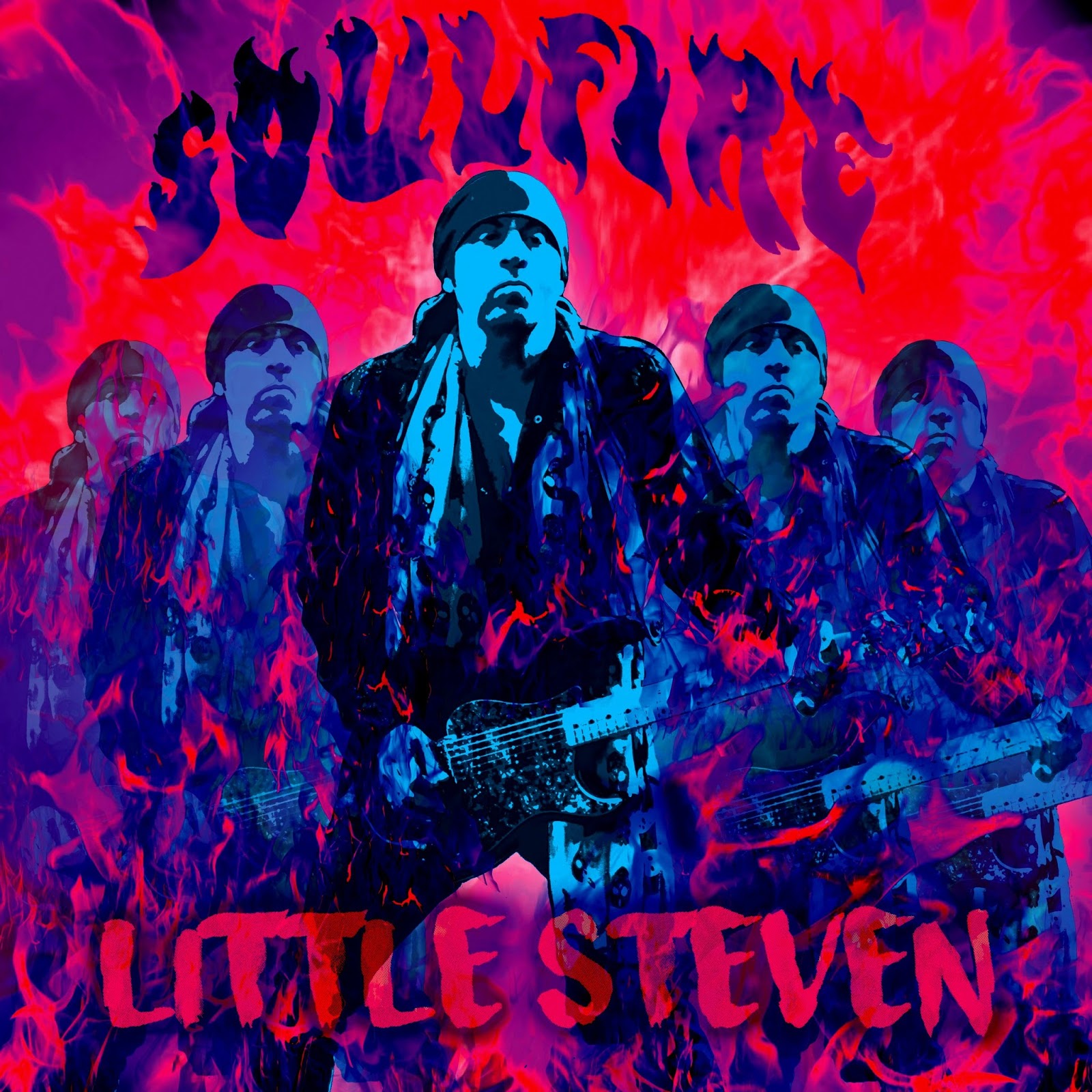
Following the Soul Fire in Kansas City: Little Steven and the Disciples of Soul at the Uptown Theater


"Rock and roll was white kids trying to make black music and failing, gloriously!" --Steve Van Zandt, interview for Albany Times-Union, 2009           

To say the Little Steven & the Disciples of Soul show at KC’s Uptown Theater was a revelation would be reductionist, one of the great dangers of rock criticism. To say it threw down the gauntlet for me to try to articulate what I’ve been up to for the past thirty-plus years is closer to the mark. I’ve told the story, too many times to count, of the way Bruce Springsteen’s Darkness on the Edge of Town handed me a sense of my own identity and purpose in my own place and time—a shy, awkward, somewhat self-destructive kid living in Oklahoma. But the lifeline thrown by Steven Van Zandt—Springsteen’s compadre, his very own professor of rock and soul since adolescence—has everything to do with how I found my way to writing about music as a way to answer its call.

           To write about this show has something to do with writing about the context of the seats stage right where I was sitting with my very own band of brothers, disciples of soul ourselves. In 1982, after Springsteen had his first Top Ten hit and returned with a predominantly quiet, depressive, folk record called Nebraska, a significant faction of his fans took solace in two other records helmed by Van Zandt that summer—Gary U.S. Bonds’ On the Line (co-produced by Springsteen) and Steve’s new project, Little Steven & The Disciples of Soul with its glorious debut, Men Without Women. Every bit as garage rock as the trashiest sounds of Springsteen’s The River, but like a glorious punk extension of the work Springsteen and Van Zandt had been doing for the better part of a decade with Southside Johnny & the Asbury Jukes as well as Bonds. It was, perhaps, the perfect Disciples of Soul record, but, after Steve left the E Street Band, the two that followed—Voice of America (1984) and Freedom: No Compromise (1987) only deepened and broadened the sense of possibility—embodying a more Prince-like inclusiveness that reached for worldwide musical textures and made political statements about issues in Central and South America, Eastern Europe and South Africa. The Little Steven project, Artists United Against Apartheid, would turn this fan into a published writer and activist.  
         
           I was sitting with friends I met through that work thirty years ago when the houselights went down May 12th of this year, and this marvelous spectacle appeared on stage. It immediately exploded with the Stax-style horns that herald and punctuate Arthur Conley’s great 1967 ATCO single, “Sweet Soul Music.” How to describe this band, a visual statement in and of itself?!
          Directly in front and above us was Puerto Rican singer and percussionist Anthony Almonte with his beautiful array of timbales, congas, bongos and, alternately, claves and woodblock in hand. Behind him was a four piece horn section, featuring original Disciples Stan Harrison and Ed Manion (also of the Jukes) as well as legendary trumpeter Ron Tooley and trumpeter Ravi Best (who's played with everyone from Kool & the Gang to Ani DiFranco to Lester Bowie) and NOLA trombonist Clark Gayton. Bassist Jack Daley (who’s played with everyone from Iggy Pop to James Brown to Beyonce) prowled the stage and bolstered the rhythm alongside Jersey Shore guitar slinger Marc Ribler (who traded lead duties with Van Zandt, while also holding down the rhythm) in front of drummer Rich Mercurio's propulsion. (Mercurio himself has played with everyone from Idina Minzel to Darlene Love.) His once brown curls now white, with a beard to match, the Youngbloods’ Lowell “Banana” Levinger sat at a piano stage left, smiling like he'd rather be nowhere else in the world. Above and behind him Andy Burton (who's played with everyone from John Mayer to Rufus Wainwright to Ian Hunter) provided the B3 and synth that gave snapping and crackling color to the garage fire throughout.
           And then there were the women—JaQuita May, Sara Devine and Tania Jones, back-up singers delightfully upstaging the rest of the show, dressed in psychedelic skintights both sexy and modest because of a wonderful array of feathers around their necklines and their hips. As if a partial answer to the problem at the heart of Twenty Feet from Stardom, these women were downstage on the right, dancing and singing like the stars of the show that they were.


     In the 36 years since the first Disciples of Soul record came out, I’d never had the chance to see them. Kansas City has never quite gotten the Jersey Shore scene (I once attended a Southside amphitheater show with about 200 people in attendance), and they’ve barely ever attempted to play the lower Midwest. Even on this night—after Steve’s legendary role in the E Street Band, returning in 2000 for more shows than they’d ever done in their first decade, and after over a decade on TV as Silvio in The Sopranos and the star of Lillyhammer, the Uptown was only sold about three quarters of the way back on the first floor. That’s the Midwest and Southwest’s loss, but hard for fans who don’t have the dough to run all over the country to see their favorite artists. All that said, I’m not at all sorry that this was the first time I got to see the band. It’s hard to imagine they ever played better or perhaps even so well, and the array of talent on that stage was something perhaps unimaginable thirty years ago. Beyond that, Steve’s voice has always been a wonderfully idiosyncratic instrument—a soulful blend of Keith Richards and Bob Dylan—but I’m almost certain he’s never sung so well as he does now.
            Case in point—and I hate to mess with the narrative of the show, but a version is available for download now (https://ume.lnk.to/SoulfireLiveWe), so maybe I shouldn’t be spoiling any secrets anyway—during Steven’s “The City Weeps Tonight,” a song he introduced with a brief history of doo wop, my own R&B teacher Billy Chin leaned over to me and said, “He sounds like Little Anthony.” I’m playing “Tears on My Pillow” as I write this and thinking about how good a call that was. Steve sang with a delicate but forceful texture--backed by May, Devine and Jones--that did its history proud.
            The show was promoting Steven’s Teach Rock campaign to aid teachers preserving the heritage of rock and soul in schools (http://teachrock.org/). He made many testimonials to teachers throughout the program, a group he called, “the most underappreciated, overworked and underpaid people in America” at a time when teachers are under attack and can really use the support. As a teacher myself who was once married to an elementary school teacher who had it far worse—more kids than she could reasonably be expected to handle (though handle it she did), not enough bathrooms for the students’ needs and not enough time in her day to take a bathroom break when she might need it—I found such a statement beyond moving. Doubly so because so many of us hated school for good reason, and so many teachers get into teaching thinking they’ll be able to inspire young minds and finding the constraints of our educational bureaucracy make every bit of good they do a heroic act of going above and beyond.
            Anyway, the show was anything but a lecture, but it had all the hallmarks of the most inspiring history lesson imaginable. Steve slowed things down at various points to talk about Chicago blues before introducing Chess Records with Etta James’s, “Blues Is My Business,” a record made late in James’s career but which captures both the Chicago blues sound and makes a brilliant statement about the times we live in today—“The blues is my business, and business is good.” After three strong statements of purpose, this song opened the show up for the first extended jam session, Clark Gayton and Ron Tooley making equally compelling statements for trombone and trumpet as more than a match for any rock guitar solo. (That said, Steve’s rock guitar has been a key benchmark for me for decades, and he proved as electrifying as ever.)
            The history lessons kept coming. Steve pointing out the Detroit groove of his Southside record, “Some Things Just Don’t Change,” while running through a litany of gifts given to us by Motown Records. “And at the top of that list,” he said, “was the Temptations, a band with five lead singers, and no one was greater than David Ruffin. I only met him once, when we were working on the ‘Sun City’ record, but I wrote this song for him.” Illustrating the very DNA of the show, this beautiful testimonial in the face of loss. The guy in that song is never getting his baby back, but that doesn’t have a thing in the world to do with how much he loves her. “The door is always open,” he sings, and it’s a testament of faith in the power of love as profound as they get.
            And this long history of the secular gospel is what keeps us going. Steven stopped again to talk about the importance of Blaxploitation movies and the incredible music made by Isaac Hayes, Curtis Mayfield and Marvin Gaye in that era before singing James Brown’s abject despair in “Down and Out in New York City.” Later in the show, the struggle of Latin American migrant farmworkers would explode into fireworks with the drive of Almonte’s percussion on the Freedom: No Compromise cut, “Bitter Fruit.” (I have to add, it was no small pleasure to be standing next to another of my brothers, Ben Bielski, a former drummer for a KC Latin music group, as his hand gestures mimicked the insane timbale fever playing out before us--that is when he wasn't mimicking Mercurio's parts.)  
            Perhaps the most succinct thing I can say about the show is that there’s way too much to talk about here. At one point, the Disciples of Soul turned a song of troubled commitment, “Standing in the Line of Fire,” co-written with Gary U.S. Bonds and his daughter Laurie Anderson, into an Ennio Morricone epic, the struggle of a love on the line as the opening scene of Once Upon a Time in the West. At another point, Steve brought the Youngblood’s Banana upfront for mandolin and Burton up front for accordion, while Tania Jones took over keyboard duties, so that he could tell the story of a grandfather worrying over his granddaughter’s inability to break the family cycle, “Princess of Little Italy.” The Van Zandt penned song for the Norwegian women rockers, the Cocktail Slippers, “St. Valentine’s Day,” hit me as an answer record to Springsteen’s veiled love song to his former bandmate, “Bobby Jean"--which is to say it spoke to all of our most intimate relationships, inside and outside of traditional romance. The AC/DC-ish rocker “Salvation,” from Born Again Savage, a 1999 record most of us missed, emerged as a climactic statement of reality and need.
          
             In the end, that’s what the show was all about and what this music is all about—our hopes and desires, yes, but our hopes and desires as needs. The show ended with the great 1987 Little Steven hit, “Out of the Darkness,” a gorgeous testament of belief in community that once prompted my first ex to say, somewhat breathlessly, “he’s so good.” Several lines sum up the spirit of the show. When I wrote about this show in a social media post, I quoted the line from Southside’s “I’m Coming Back,” "I’m getting tired of living in a world that’s got no soul,” saying that those words, at once, never rang more true while being dispelled—the whole night a refutation. But I think the real key to the show may lie in the title track to Steven’s new album, the title of the tour, “Soulfire.”

            Steve doesn’t bury the lede, this is generally the opening song of the tour, and the opening original of the show I saw. It begins with this ringing two or three string guitar chord, like morse code, those synths pressing behind, announcing important news to follow. It’s a song about two strangers meeting, one recognizing the grief and terror in the other as mirroring his own. He knows there’s a way out, and he knows it’s together. They take hands and follow the soul fire toward salvation. The best band imaginable playing hard, tight and passionate all night, Little Steven & the Disciples of Soul made it easy to see the light.


Thank you to William Heaster for the great tickets. Thank you to Shawn Poole for the quote.


Saturday, May 12, 2018

Remembering Shelby Starner: Music Criticism, Spoken Word and What We See When We Look in the Mirror


Last night, I participated in a wonderful spoken word fundraiser for a play called Mirrors by a sharp, thoughtful young actress and playwright named Kaitlin Gould. Listening to her talk last night, it was evident she knows more about the dangerous myths and misconceptions surrounding body image disorders than I could ever hope to know. That, in and of itself, made the event important. 
But this event was produced and emceed by another wonderful young artist (also producing the play) named Athena Louise Hyacinth, and it featured stirring poetry from Cecilia Belser-Patton, Jen Harris, Samantha Slupski, Asia Raine, and Nkenge Burkhead (all of them accessible, funny and moving, connecting me most deeply around how we learn to love ourselves despite the world’s—and often our loved one’s—discouragement). I want to write about all of these women more in the future. But I was distracted last night by my own job as a reader, so I can't say much more specifically. I thought I’d share, instead, what I wrote because it feels important to do so, even more so today than before I met all of these fine folk building unity and understanding around these issues.
When I agreed to do the event, I talked with Ms. Hyacinth about a musician I’ve been thinking about for 19 years, a musician who only lived 19 years. Her name was Shelby Starner. Instead of dusting off my poems, or even trying to write a new one, I decided I should do some of what I do best, music journalism, and write about Starner, not just in terms of our interview 19 years ago, but in terms of what she and her music still mean to me today.  

I began by playing the opening track from her debut, From in the Shadows, a song called, “Fall.” https://www.youtube.com/watch?v=7uuDFkL5wSw
Then, I read her 2003 obituary that ran in the newspaper of the coal-mining town where she grew up. Here’s some of what it said:
Shelby E. Starner, 19, of Bartonsville, died suddenly from natural causes on Saturday evening, June 22. Born on January 3, 1984 in East Stroudsburg (PA), she was a daughter of Ray J. and his wife, Susan (LaRose) Starner, of Stroudsburg and Katherine (Haas) Benn and her husband, Allen of Bartonsville and had lived in Monroe County all of her life.
She was an independent study student planning to attend the University of Pittsburgh in August 2003. She was a writer and musician and her music has touched many people. Shelby was a creative, intelligent and loving person.
She is survived by a sister, a step-brother, maternal grandparents, and a paternal grandfather. She was preceded in death by her paternal grandmother, who died in 1999. [The year her album was released.]
In lieu of flowers, the family has requested that memorial contributions may be made to Doctors without Borders (www.DocterswithoutBorders.org) or to the Shelby Starner Memorial Scholarship for Excellence in English.
                Then I read her a letter.
Dear Shelby….
When your father called me and told me you died, four years and four months after our interview, I didn’t know what to say, of course....no one ever does. The piece I wrote about you obviously meant something to him, and probably you, because he tracked down my number and called me in my little Kansas City, Kansas apartment. This was in the days before I had a cellphone—no Facebook, no social media at all to speak of…It took some work.
I said I’m so sorry. I said how much I enjoyed talking to you, how much I loved your music. It was all true.
I may not remember all the details, but I remember a bubbly 15 year old girl on the other end of the line, a girl who’d met her idol Stevie Nicks and wanted to be Steven Tyler too. A girl when asked about Ani DiFranco not only described how much she admired her as a “musical crusader” but also as “a tough cookie.” I remembered a bright and shining light (not anything like the many flickering flames I’ve worried about over the years).
It was baffling that you didn’t live to see 20. You’d been spotted by Liz Rosenberg, the top ranking woman at Warner Bros who put all her money on Madonna, and you’d been signed to the same label. Your second record was to be a collaboration with the Red Hot Chili Peppers. You’d taken time off because your mother was sick. You’d taken time off to go to school. You were smart and talented and lucky and cautious and….
Now you were gone.
Somewhere there’s a tape of the two of us talking. I’ve saved it and tossed it from box to box over the years, but I don’t know where it is right now. What I know of your speaking voice is what I said at the time….
I describe our conversation as “refreshing,” and I call you “candid” and describe you as “every bit as unaffected and unflinching as [you seem] on record.”
I say you “enthuse”
I talk about your laughter, open and often…
I say “Starner’s spontaneous answers speak so naturally of universal life passages that it is easy to forget that the stages she is talking about may be a grade or two in school half-forgotten by adults.” But, I add, “it becomes clear that not only was she a precocious child, she also learned a great deal about life very early.”
You talked all about that in ways I could easily relate to. We were both children whose parents divorced in our childhood, so I got it when you said, “When I was really little, ever since I was two, I always wanted to hang out with the adults, and I always wanted to be like an adult, so I tried my best. And then I got to a certain age and I realized, ‘Wait, these people don’t try their best!’”
But immediately after, you began to tell me things that I understood in a certain way then…and understand in a different way now. 
You said, “I always wanted to be older when I was little, and some of it was because I was really, really, self-loathing in a physical way. People meet me and I’m so hyper and out-of-my-mind all of the time, they don’t assume that I had insecurities and I was completely out of my mind for a couple of years when I was little.
“In about third and fourth grade, I developed a body. I was already 5’ 2”, and I had curves, and everyone around me was little, and I was terrified. I thought I was deformed. So I would dress like a boy. I wore huge clothes to hide myself, not let anyone know that I was a big girl.
“I’ve always been shaped, you know, physically shaped, and I wanted to be with the adults because I felt comfortable with who I was and what I looked like.
You went on…
“I was a dancer. That’s what I always wanted to do. I took dance lessons from the time I was two and a half until last year. And I would come home after dance classes and cry, because I was not five feet tall, and I did not weigh 85 pounds. Every time I got a costume to do a show, I looked like the 10 cent hooker, and everybody else was like these pretty little ballerinas.  
“When I was in about 4th grade, I really got into the whole Aerosmith thing. I saw Aerosmith live on MTV, and I was just watching Steve Tyler fling himself upside down and backwards and swing around on stage, and I went ‘Oh my God, I want to do that!’ and everything just kind of snowballed from there. I don’t know how Mom felt about me running around the house singing “Backstroke Lover,” having no idea what I was talking about but singing my little heart out. [I’d quit piano before] but I guess I decided around that time, if I sat down and played the piano, I’m going to play Aerosmith, and I’m going to play Led Zeppelin, and I’m going to play the piano like nobody’s ever played it before.
“Eventually I just started playing things all on my own. You can teach anybody how to play Beethoven. Even if they don’t want to do it, you can tie them down and make them learn how to do it. But creativity, and really good records, the passion that is on records and in a live show, nobody can make somebody do that.”
So you made demos of 26 songs, and k.d. lang producer Craig Street helped you narrow that to 13. You made a beautiful record, ridiculously ambitious and, at-its-most-focused, absolutely devastating.
No, it wasn’t a hit. Most of the best don’t make a hit the first time out or ever, but you had international press, and you were working on a comeback....
And you and your body were at war with each other.
A 35 year old man talking to a 15 year old young woman, we probably had no chance of talking about our bodies, but some of what you told me I certainly see where I should have understood.  
We can start with my war with my own body. My childhood asthma put me in the hands of a pedophile savior. The doctor who molested me had to protect me from my body. I eventually combated that shit by getting all kinds of high and eventually even taking up my most banal enemy, cigarettes--strikes one through 87 in the war with myself.
I was also always the big kid among my friends. I was also more comfortable with adults. I also felt deformed. In a 2014 Journal of the American Medical Association Study, one in five young men were found to have serious concerns about their weight. I notice the bodies changing on the young men in my classrooms, and I wasn’t surprised when a student of mine wrote a paper, just a few years back, about how she wished she could find someone her own size to date. We don’t talk about it, and it grows when no one talks about it, but everyone suffers in a world where even the concept of what we should like can be commercialized. There are profits to be made from starvation and steroids; very few in positive self image.
I don’t want to go off on the politics of body image, although thinking about you this week has had me thinking a lot about them. My music writing started out political because music gave me a sense of my own power and a way to take on power issues in our society—big ones like apartheid and racism and free speech. But, eventually, my writing would start navigating the more subtle issues, the politics of the bedroom and our most intimate relationships.
I’m not sure I ever worked my way down, enough, to the politics of the dinner table, the bathroom and the bathroom mirror. Shelby (and everyone here tonight), you’ve got me thinking about that now—how the economy reaches down and robs us of our sense of control even over our own bodies, the one thing you would think we could call our own. Yes, indeed, “our bodies ourselves” is a revolutionary statement.
But let me end this by talking about why I wrote about you in the first place, Shelby, and why I’m writing about you today. In our celebrity-crazed culture, it’s easy to imagine most people have no idea what it meant for me to become a music writer, but it’s not that different than what it meant for you to become a musician. Music showed me a place where I could be myself, where I could be redeemed and proud and let my dim light shine brighter than I might ever have thought possible.
Since I couldn’t play piano like you or write songs like you or sing like you, I found my way to this culture of people who write about music as a way of making our own kind of music. That’s how we used to think of music criticism back in the day, sitting on our beds reading magazines—people like me were reading other people like me fashioning a verbal response to the call we heard in the sound of the music. There was a time it felt like another front in a counterculture. As deejays were to emcees were to break dancers were to graffiti artists in hip hop, the journalist was another voice in the heart of the culture. I hope, on some scale, it can feel like that in moments like this.
Anyway, contrary to the snotty image of the music journalist, I think most of us do it because music turned us on and told us to do something, and these were the tools we chose. I’ve written about music for thirty two years because I love music and because I love musicians. Because people like you, Shelby, taught me how to feel free and to live as my best self. Time and time again, you have all helped me find redemption, if even for a moment.  
Your would-be hit single sang about “being a woman and not a girl in this man’s world,” and that record reached across age and gender lines and helped redeem me. https://www.youtube.com/watch?v=zTAJGiy8If0 
It hadn’t been easy to be a boy or find a  way to be a man in this world either. Music, and your work, showed me a way. My opportunity to promote your work, to tell your story, helped me find a way to respond to the power of the call I heard in your music. It’s a very human thing we’re engaged in, and it’s in service to the music. But it’s certainly imperfect. (There’s a reason musicians and artists often hate critics, and most of them are justifiable.)
But what we need to remember is what set us on our path—the humanity that ties us together. We need to remember what bridged the gap between us is in the yearning of the human voice. It wasn’t Aerosmith for me; in truth, it was more Shelby Starner, a whole string of musicians that brought me to you.
And the fact that I couldn’t do more, the fact that I didn’t know….Nothing about that is okay.
And it’s no comfort to say it simply shows how far we have yet to go.
At least we have your music I could say. 
I know some of why you made it, and it does live on...
But I’ll be damned if I say that’s enough.

(Thank you to CJ Janovy and Sam Bell for your advice and support.)

Sunday, April 15, 2018

Resistencia: Round 2--Love, Bodies and Borderlands

"Art is the perfect weapon because the more you try to destroy it the more it inspires others to create it"--Huascar Medina, Resistencia: Round 2

(Pictured, Lucky Garcia, Resistencia: Round 2)


I missed the first one, regrettably. But last night’s “Resistencia: Round 2” at Uptown Arts Bar may have been the most focused, hard-hitting and intimate poetry reading I’ve ever attended. Part of it were the headlines (and lack of headlines) in the current news. The bombing of Syria while our country refuses its refugees and criminalizes its own people with attacks on free speech (see, among so many like them, deportation threats against Maru Mora-Villalpando for speaking out about ICE raids, the imprisonment of Reverend Ed Pinkney for fighting the corporate takeovers of his community, and the arrest of journalist Jenni Monet speaking out about Standing Rock).

At the reading, another journalist (poet/artist…) MG Salazar explicitly tied the crop dusting of protesters at Standing Rock to the gas attacks in Syria. Salazar’s reporting from Standing Rock has taken the form of a book, Striking the Black Snake: Poems from Standing Rock. Fighting a terrible cold, Salazar read from that book, making us feel the gritty realities of those struggles. A migrant farmworker as a child, Miguel Morales acknowledged his own experiences facing crop-dusters as an intrinsic, terrifying part of his childhood. Iraq war veteran Lucky Garcia carried these parallels even further, in one poem mirroring her experiences in Iraq with daily dread living on the east side of Kansas City.

Garcia, who called herself the “rookie” of the group, pointed out that she can still be “called up any time” before reading a poem, “Dear Mama,” about what the war had done to her. Things that, despite all the love in the world for her daughter, her mother could never understand. The house shook with her imagery, such as her tying the scent of her mother’s morning bacon to the smell of an IED explosion. She closed with a portrait of Post-Traumatic Stress Disorder, a tour-de-force building all of the details around the framework of those four letters—P and T and S and D.

But the politics of the evening took many forms. Emcee of the evening’s events, Alex Martinez kicked things off with a poem called “Glass Breaker,” which drove home ways in which one’s very own identity, being one’s self, necessitates a form of resistance. Miguel Morales echoed a poem Martinez read about the complexities of living in a body misunderstood and maligned by the power structure, closing one poem with the line, “This body is a borderland.” Although Morales said he wasn’t going to read his more political work that night, as he had during the first Resistencia, his tender, dignified portraits of working class life (and his two directly contrasting takes on Cinco de Mayo) were, in many ways, more political than anything that’s on this morning’s talking head TV.

Similarly, Jessica Ayala began with her overtly political work—speaking of the 43 disappeared Mexican students and her book’s title track, “Huelga.” But so much of the politics in Ayala’s set served as a celebration of the resistance inherent in artistic expression. She began by singing, and during her heart-shattering tribute to her father and music (named for the great Columbian musician Joe Arroyo) she tied the movement in Afro-Cuban rhythms to the resistance of all enslaved people. And if it’s not clear I’m saying she made it universal, let me underscore that point. If she didn’t dance during this reading, it seemed as if she did, bringing the reading to an exalted climax well before it was over.

Many of the night’s poems were love poems. The role of love in resistance was something no one had to explain. Guest reader Huascar Medina even delivered a twisted but beautiful love poem to Sylvia Plath. His final poem, “My Siren,” about the loss of a loved one to addiction, underscored just how high the stakes can be—the first political struggle always being the fight to find the love that keeps us from doing ourselves in. The whole evening fed that hunger in endlessly inspiring ways.

Wednesday, April 11, 2018

Ten In A Million: Turning Points

Over the past two weeks, I took part in the Facebook game where you are supposed to post the covers of 10 albums that have meant and continue to mean a great deal to you. Since I have a terrible time choosing between favorites, I decided to pick 10 albums that a) changed the way I hear music and b) are little known or don't seem to get the attention I think they should. By day three, I had two friends ask me to provide some writing (a violation of the rules of the game, but an invitation I couldn't turn down). After I did this writing, I didn't want to lose it, so I've compiled it here because, well, I think these things matter. DA
#1. Aaliyah, "One in a Million"     
Grief is a strange thing. I've maintained my composure when those closest to me died, even teaching class within twenty minutes of hearing an absolute best friend took her life. When Aaliyah died, I absolutely fell apart. Only Lauren, my girlfriend at the time, knows the truth of this. Lord, I must have traumatized her.
Why did the death of a 22 year old singer so tear up a 37 year old music journalist?
I suppose I was grieving many things at once, but it was only Aaliyah who could have provoked that reaction.
After the exuberance of hip hop in the late 80s and early 90s (which seemed truly the last expansive musical revolution, ripe with possibility and vision), after the deaths of Tupac and Biggie, after the thinning of a movement of women artists who dominated the charts until just about the moment this album came out, I'd hitched my wagon to Aaliyah's star.
And I did so because of this album, on which she defined an aesthetic unlike anyone else. Yes, Mary J. Blige earned the title Queen of Hip Hop Soul, but Aaliyah was a contender, perhaps not from the moment of her debut, but certainly by the time she made this record. She explains her singing style by covering Marvin Gaye's "Got to Give You Up," Gaye's sweet, sensual style a model for her voice. But the thing that made this album truly something new was the way that voice danced all around and all over and slinkily around and through producer Timbaland's staggered, edgy beats. In the same way Eric B. & Rakim's debut seemed like an elemental exploration of the elements of hip hop, Aaliyah's voice defined possibilities for hip hop soul that others have imitated but no one has come close to capturing.
That's because, I think, no one can capture a soul, whatever a soul may be. Aaliyah didn't belt and shout like so many of today's singers. She did just the opposite. It always felt she created a greater tension by holding back, by rendering her emotions with sleek, smooth control. She practically whispered in your ear. Still, she used that voice to convey every emotion imaginable in the short time she had to say what she needed to say.
I don't believe she ever made her best album. Objectively, that would probably be her last, but she was poised to blossom for years to come. This album, her breakaway from R. Kelly, promised as much, and, like Aaliyah herself, it's forever sacred in my heart.

#2 Warren Zevon, "Bad Luck Streak in Dancing School"  

Maybe it was the fact that I was a viola player until graduation, but this record, Lou Reed's Street Hassle and Van Morrison's Into the Music, all grabbed me when I was still in high school in part because of the way they used strings. In this case, Zevon contrasts these sweet classical interludes with rock so hard it doesn't seem right it came from California, or from a cohort of Jackson Browne's. The opening song--with its repetition of "down on my knees in pain"--speaks very directly to me about everyday struggle, and the way it sets the struggle as a hard pratfall in a dance class fits the overall juxtaposition of the record in a way I still find thrilling. The polar opposite of the title track is my equally favorite moment. While this record is bare-fisted fight rock 80% of the time, "Empty-Handed Heart" may be the most delicate love song conceivable in this setting. And it still gets to me the way it always has--like, I need to pull over when it comes on in the car.

#3, Eric B. & Rakim, "Follow the Leader"  
"No dictionary's necessary to use
Big words do nothing but confuse and lose
From the first step, a concept was kept
To the end of the rhyme, it get more in-depth," "No Competition, Eric B. & Rakim
My friend David Cantwell had two albums framed to hang on my wall because he knew just how central they were to my soul and sensibility. They're still on my wall after who knows how many years. One is Bruce Springsteen's "Darkness on the Edge of Town," the record that, in many ways, shaped my identity in relation to music. The other is Eric B. & Rakim's "Follow the Leader," a record I obsessed over the year we met, the year I started my first paid writing job,1988, an incredible year for hip hop. Released one month after Public Enemy's "It Takes a Nation of Millions," the same day as Salt-N-Pepa's signature "A Salt with a Deadly Pepa" and just a couple of weeks before N.W.A.'s "Straight Outta Compton," "Follow the Leader" was a key player in a wave of ambitious leaps that would forever change the boundaries of hip hop.
From the moment I met my friend William Heaster and he gave me a cassette of Eric B. & Rakim's first album, '87s "Paid in Full," I went from being a casual rap fan to a fanatic. (Like many in my era, I'd been shaken by Kurtis Blow, Grandmaster Flash and the Furious Five and any number of Run DMC tracks.) But Eric B. & Rakim's "Paid in Full" took me somewhere else altogether. I think there's an interesting parallel between the first generation of rock and rollers and the self-conscious (as in self aware) rock and soul musicians of the 60s. Rakim's lyrics took hip hop apart and examined the elements; Eric B.'s beats and scratches were as absorbing as any rock sax or guitar. That is a perfect album, as stark and bracing as this follow up is lush and sweeping. It's really like picking between "The Godfather" and "The Godfather, Part II" to weigh one against the other.
The key difference, like so many rap records in '88, was a fuller, faster, more frenetic sound. After hearing the incredible Coldcut remix of "Paid in Full," "Follow the Leader" sounded like a sequel as an extension of that reimagining of sonic possibilities. Rumbling bass prowls just under a mindboggling array of beats, whirling dervish disembodied voices, stabs of horn and strings and Rakim's verses, "traveling at magnificent speed across the universe." Rap had absorbed the history of rock and jazz and soul and freed all of it from any sense of limits.
Central, of course, to all of it were Rakim's distinctly urgent but cool vocals. This MC refused to shout to make his points--he kept his white knuckled attack sleek and, as I remember Greg Tate described so eloquently at the time, lethal. On a quiet track like "The R," with its eerie late night keyboard, you can hear a prophecy of "The Chronic" and Snoop Dogg.
But Eric B. & Rakim never fell into the sort of nihilism that would soon overtake so much rap. Rakim's contemplation of the elements of his art--Eric B.'s fearless scratches and beats, the audience both in the crowd and at home, and the expressive weaponry of the MC's verbal dexterity--all served the cause of personal and communal liberation. I know I was never the same, and the many samples of this music that would infuse hip hop future show I wasn't alone.


#4, Go-Go's "Beauty and the Beat"   
Before the Go-Go's, the women I listened to--Patti Smith, Chrissie Hynde, Rickie Lee Jones, even Stevie and Christine of Fleetwood Mac--were, to varying degrees, exotic counterpoints to the male artists I identified with more directly. (It's probably worth noting, at that point, I still thought of soul as my mother's music and country as my father's music, so the sounds that would later overtake me weren't factored into the equations much.) The Go-Go's were certainly distinctly feminine, so clearly being girls, but I identified with them the way I identified with male artists. I feel like it must be somewhat parallel to the way many young women experienced The Beatles differently than other male artists. And it so appealed to me on a par with any artists I loved--particularly Charlotte Caffey's fine songwriting--that I forever opened up to sounds the little boys aren't supposed to understand. At 17, this was a very big deal....almost forty years later, it still is.

#5, Karyn White, "Karyn White"
In 1988, I was 8 years into a relationship and four years into a marriage, and I found myself seeking--often bold, accusatory--therapy in music made by women. I'd been prepared by Janet Jackson, Pebbles and Salt-N-Pepa, but Karyn White's album-length blend of the excitement of hip hop and the maturity of soul hit me right where I lived. I needed both of those things in the equal measure allowed by her tender-tough vocals and brilliant production by L.A. Reid and Babyface. My constant play of this record in 1988 (one of my first Pitch reviews, along with a very similar record by Angela Winbush and Mariah Carey's debut) has everything to do with the Mary J. Blige book I wrote almost three decades later. In fact, I start the book with White.

#6, Ian Hunter, "You're Never Alone with a Schizophrenic"  
I can't overstate how important this record is to me. I didn't know Mott the Hoople as anything more than a name when this record came out (though "All the Way from Memphis" was featured in one of my favorite movies). I'm sure I bought it because Max Weinberg was on drums, Garry Tallent was on bass and Roy Bittan played keys. But from the opening beats of "Just Another Night," I realized this wasn't the E Street Band I knew. They seemed to be playing with more abandon, hitting even harder (and that's saying a lot) and, in some ways, shooting farther. The sounds here blended every aspect of rock that had drawn me since childhood--it was grand, sometimes even psychedelically textured and colored, always excited and exciting. It was also just the record for a variety of purposes. At the end of the day, my brother Kent and I would put this on in the darkness of our room and fall to sleep to it. But when it came time to face the real world, its brash-punk sensibility suited the fight. Songs like "Bastard" and "Standing in My Light" helped me navigate high school halls. One of my favorite songs ever was the manically agitated "Life After Death," a way-over-the-top rocker played hard enough to earn every bit of its call for everyday resurrection. Did I believe? Do I believe? "Oh yeah!"

#7, James Blood Ulmer, "Are You Glad to be in America" 
I'm 17 and about two years into an exploding musical universe that has changed how I see myself, the world around me and my role in that world. Two years before, I'd seen and heard Ornette Coleman on SNL--I remember one of my older brother's friends dancing across the room to that horn, and from that moment on I'd been fascinated by this mysterious separate set of rules Coleman called harmolodics. But this album by Coleman's student Ulmer turned that fascination into something very intimate. It's a dischordant, intoxicating funk--in which horns, guitar, and drums attack a revolving center and throb like lift-off--in some perfect balance of frenzy and suspension. It took me all day to even think about putting words to this one because it would take me days and days to get at why this is a go-to record for me. But if I need to be shocked out of a stupor and back into life, this does it every time.

#8, Ruben Blades, "Nothing But the Truth"  
In 1988, I was being radicalized by Iran-Contra. A lot went into that, starting with The Clash's Sandinista and climaxing with the Sun City record. I'd joined Amnesty International first, and then become involved with Oklahoma City's Peace House. I'd met Benjamin Linder's parents (he'd been killed by Contras while helping Nicaraguans with a hydroelectric dam), and I knew refugees from El Salvador. I'd met women who lived under apartheid and gave me a perspective I'll never forget. The anti-apartheid movement informed my own efforts on campus to help with the Black Student Union's fight against David Duke and the Klan's evangelical works on campus. I was awakened to the complicity of this superpower's fundamental structure when I saw Oklahoma Democrat David Boren throw softballs to Oliver North during the hearings. The death of murderous Guatamalen dictator Rios Montt this week--a man trained, heralded and supported by the U.S. government for the open genocide of Mayan Indians--is a vicious reminder of how much my perspective of the American ruse came clear during those years. And along came Ruben Blades' first English-language album. Undoubtedly not his best album, but crucial in my development, finding a solid link between the Lou Reed and Elvis Costello I knew so well and the politics and the music of this exploited world that preoccupied my mind. For what it's worth, I think it's a gorgeous record, and it holds up, not just for its indictments of the dictatorship in El Salvador and the hero-worship of Oliver North, but for it's gentle reflections--songs like "Letter to the Vatican" and "Hopes on Hold," with lyrics throughout engrained in my psyche as firmly as any music anywhere. And then there's that voice. Very few have ever sounded so sweet on a blue note, and his hat tip here to Marvin Gaye shows he knows the debt he owes.

  #9, Cidny Bullens, "Somewhere Between Heaven and Earth"
"There's no rhythm in the rain/There's no wishes in the stars/There's no power in this pain..."
It's so strange to hear this record with my dad gone. He loved it. I remember him absently scratching his side the way he'd do and saying "That 'Boxing with God...'" He'd then be thinking through the right words to convey what I already knew. It's how Dad experienced life. It spoke for his constantly questioning sense of faith. Every day was a struggle.
Of course, hard focused on the the death of Cidny Bullens' 11-year-old daughter Jessie, "Somewhere Between Heaven and Earth" is ten bloody rounds, even in the album's closing defiance. "I might be going down, but I'm no quitter," Bullens declares over hard guitars and pounding drum. It's the plain truth you hang onto while this parent sings through grief in the starkest possible terms. (I'm doing good not to crumple right now while Bullens' other daughter Reid sings her refrain on "As Long As You Love.")
This one's been on my mind a lot lately, in part because of Bullens' work for the Columbine families. But I'm two decades older, now. I live with losses I never could have imagined then. My friends know loss they couldn't have imagined either, and that I can't quite grasp. This album takes all of that on, with remarkable beauty and strength. It's a truly singular gift, fashioning power out of powerlessness, then passing it on.

#10, The Beatles, "The Beatles Again" or "Hey Jude" 
"For well you know that it's a fool who plays it cool by making his world a little colder."
When I heard the Beatles broke up, I was 6 years old, standing in the Bartlesville, Oklahoma Pennington Hills IGA with my mom, doing her weekly grocery shopping. I picture it as the cover of a checkout tabloid, but I believe it was simply part of the many conversations my mother would have with the people who ran the store and other shoppers.
That summer I would buy my first 45 at a mall in Atlanta, Georgia. It was War's "Spill the Wine," seemingly part of the constant AM radio soundtrack of the family trip. I loved the sly funk on the back side of that single's ""Magic Mountain" maybe even more than the hit. "We're going high, high, high, and never coming down!"
That Christmas, my brother James gave me "The Beatles Again" (also called "Hey Jude"), what I presumed to be the band's last album. We moved that year, a hard change for me, and I remember playing that record over and over and over again in the rec room of that new house. The second side opener, "Hey Jude," in particular, is the song I think of getting me through that move and the dissolution of my family--my parents fought hard in the years leading up to their divorce, and my teenage brother began to hit the road when he could. They were each there for me individually, but I wanted the band together. That wouldn't happen again, but I'd always have the record.
I'd always known the Beatles. I kind of thought they were music or something--them, Elvis and Stevie Wonder. Arriving on Ed Sullivan when I was four months old, they were always in the air. But it's funny to think of the way my 7 through 10 year old self heard this as a selection of songs recorded together in the studio. Album opener "Can't Buy Me Love" was released one month after the mop tops hit American shores, and the songs that really defined the album for me--"Revolver," "The Ballad of John and Yoko," "Don't Let Me Down" and "Hey Jude," conveyed the band's fully mature hard rock grandeur. (If that doesn't sound like "Hey Jude," you're forgetting the final four minutes.) Sure, four years of recording doesn't seem like a lifetime's distance, but it was for The Beatles, who looked for all the world like old men on the album cover. (The oldest Beatle, Ringo Starr, was 29 on that shoot.)
At least to my admittedly biased ears, producer Allan Steckler made smart choices from the many B-sides and non-album singles he used. He managed to fold all of the Beatles' chapters into a solid whole, "Rain" and "Paperback Writer" representing brilliant polarities of the band's mid-career studio ambitions. But maybe that's just the wonder of happenstance with such great music. Either way, the collapsed boundaries between shining pop, hard rock, soul and even a kind of funk had more to do with shaping my sensibility than I'll ever know.