Reason #1--We Can't Afford Any More Witch Hunts
(Starting today, I'm going to try an approach to this blog that I haven't before--because of a personal sense of urgency and time constraints. I will give myself a half hour to write whatever it is I've got to write in the morning, post it, and then, once I've gotten the work of the day done, I will reread it and consider what I might add or subtract from what I've done. For this reason, if you pop in here midday and find something interesting to you, you may want to check back on this date's blog again later in the day, the next day, whatever, to see if anything's changed. I think that system will allow this guy who's used to writing for publication deadlines, one way or another, to feel more spontaneous because I can always go back and "fix" things in a way that I'll be more comfortable with them standing later.)
Morning rough mix--
Standing at O'Hare on my way home Sunday, The New York Times front page gave me a chill. Under a picture of red flags and images of Che Guevara was a caption that said something like "Anti-American Rallies Increase" before explaining that Middle Eastern political organizations like Hezbollah were demonstrating with communist groups, representatives of and those inspired by the defiant voices of Fidel Castro and Hugo Chavez. The protest didn't scare me; the branding did. That picture and headline wouldn't have seemed more menacing to me if it had said, "Run Critics of Capitalism: Hide If and While You Can!"
The reasons for my reaction may or may not be obvious, but that's part of why I'm up writing this morning. I choose to view the future with hope rather than fear (I'm not sure I could get up if that wasn't the case), but the storm clouds on the horizon right now are scarier than anything I wrote about in those 13 days of horror essays I last wrote. And one of the reasons for that is one of the keys to humanity's hope when it's faced with its monsters--that character in every tribe of fearless vampire killers, every band of Scoobies, the keeper of arcane knowledge.
I talked before about one legacy of the Cold War being the erasure of anything but a caricature of Marxist thought from our society's discussion of the issues of the day. When we live in a system where the average individual's cash on the barrelhead value is being driven down to zero (as the WID-ER report shows in my last blog, often below that), and the economy's fuel--the gold standard that keeps things running--is the industry of war supplemented by service industry, the last thing the system (not some Star Chamber of elites but something more fundamentally real, the agreement of all of the forces that keep society running smoothly) wants is anyone taking stock of the situation and suggesting a more humane basis for society.
It is hard to imagine a society getting more dumbed down than the one we currently live in. (And I don't mean the kids people like to blame 'cause they often have far more insight than their parents. The reason I started writing Monsters, Marx and Music was because it's in this pop culture both conservatives and liberals like to attack that some real resistance to the status quo manages to stay alive.) But it will try to get dumber if it can because that's the best way for it to keep the fires burning. That's what Ray Bradbury got right when he wrote Fahrenheit 451, where the books only remained in peoples' minds. And that's what I think Stephen King really meant, whether he knew it or not, when he recently wrote that he'd imagined some pretty scary things in his life, but he'd never imagined Nancy Grace.
Tuesday, December 12, 2006


Thursday, December 07, 2006
Check the Dogma at the Door
"All I know is that I am not a Marxist."
--Karl
“I refuse to join any club that would have me as a member.”
--Groucho
Today’s daily reminder of the black hole in our educations where Marx oughta be comes with the release of the new report by the U.N.’s World Institute for Development—Economics Research (WIDER). Measuring components of household wealth often overlooked by similar studies, this research finds, among other things, that the top 2% of the world’s rich own more than half of the world’s wealth, that the United States has a fourth of these people and that the U.S. has twice as much income inequality as most other nations. In fact, despite the U.S.’s great wealth, many Americans have so much debt that they are among the poorest people in the world.
I’m afraid the ultimate price of the Cold War is that we look at statistics like that and shake our heads, but we don’t think we can do anything about it. Marx spent his life trying to convince the world that an economically just society was not only doable but a moral necessity. Hardly the dreamy idealist or zealous extremist all sorts of people picture when they hear the name, Karl Marx was more like some ancient Greek who applied basic intellectual rigor to examining the fundamental nature of the system around him. Like Plato, he dreamed of ideals, sure, but like an Aristotle, he rolled up his sleeves and insisted on working toward these ideals with a thorough examination of the material world. And like Socrates, he didn’t shut up until the breath left his body, working on showing his math in three volumes of his study of capitalism.
Sadly, we live in a society where all of this work has been labeled un-American. Money makes the world go around, and to seriously contemplate an alternative is to be a flake at best, a traitor at worst. It’s tragic. Because while most Americans are waking up to the fact that the best way to run U.S. foreign policy (or, more particularly, a war) is NOT to ignore reality and contradictory opinion, we still do so with our own unexamined assumptions as capitalists. Ignoring half of the past century’s old worldwide debate is not a good way to step into the future, and in the long run, I’m positive the ghost of Christmas Yet to Come has nothing good to show us as long as we continue down this path.
So, I started writing about what I’ve learned from Marx six years ago, and I want to get it out among those I know and love so we can talk, not about capitalist or Marxist dogma but about these unexamined assumptions and how to revisit them. I can’t see any hope as long as our society remains in denial. Over the next few days, I’ll be pouring back over the Marx portions of Monsters, Marx and Music for the dozen or so fundamental reasons I think this. Expect my next marathon of posts to come from this place.
Meanwhile, read the WIDER article--
http://www.wider.unu.edu/
And spend some time with Kristie (see below). You won’t regret it.
Tuesday, December 05, 2006
Have It All
47 posts ago, I started this blog talking about two women who have helped me through some dark places, Mary J. Blige and Kristie Stremel. Almost a year later, Mary J's reaping her just rewards for an album, The Breakthrough, that lived up to its name both commercially and artistically. Meanwhile, Stremel is about to release her own breakthrough album, 10 years. I am so excited about this that I've tried to help how I can, mainly by contributing a new bio to her website that I hope captures some of the signficance of this artist who has given me so much over the past decade.
Here's what I wrote--http://www.kristiestremel.com/bio.php
And check out her new video, "Have It All"--
http://www.kristiestremel.com/news/index.php?entryid=4
After you hear that, you really oughta listen to "Paper Heart"--http://www.kristiestremel.com/audio/10years/paperheart_sample.mp3
If you wanna remember why music matters so much, spend some time with her music. She teaches me something indispensable every time I do.
Danny
Friday, November 17, 2006
Doodling Fear Away
Since Halloween, I've suffered writer's block. I started working on a new novel a little bit but not in any disciplined kind of way. And now I'm getting glimpses of what I want to write, mainly about the things that have been speaking to me--the new albums by Ludacris, Jerry Lee Lewis and the Who and Dave Marsh's new Springsteen book, In Concert, all wonderful present tense reminders of why I've spent most of my life doing what I do. The urge to write about these things started Wednesday morning, after a good conversation with my Tuesday night class.
We were talking about the graphic novels section of their fiction textbook, and one of them, Josh, pointed out the book's bias against conventional genre comics in favor of more obscure examples from around the world; his brilliant friend Nicki gave the sentiment an amen. (The book's two best known examples from American popular culture were a two page excerpt from Maus and a Lynda Barry piece called "The 2 Questions.")
This led us into a discussion of how and why lit text books (and arts classes in general) are biased against art that is actually a part of most peoples' daily lives. As someone who assigns Charlotte Perkins Gilman's "The Yellow Wallpaper" and whatever Poe I can find every semester as a desperate effort to represent the horror story, I know the bias all too well, and we got it all out on the table and talked about it.
What we really got at are parallel themes in our stories and these observations--for instance, the way the artist is always poised in conflict with society and the way true love always takes place outside of society. However conscious we can agree any of these intentions are, I think we could agree that the social system (and academics--much as it likes to believe it is above the fray--is very much a part of that system, justifying it in the most insidious ways), at least the one we live in, wants to crush anything that clogs its gears.
Being fully human in a system fueled and governed by a fight for wealth and control is a pretty gear clogging desire. But it's the heart of art. The amazing thing about an album like Ludacris's Release Therapy is how it works the system to lodge a wrench right where it can do the most damage, giving so many of us much more room to live and breathe and dance and create than we would have had without it. Just me typing these words is my example for the moment.
I've been down. My daughter lives away from me for the first time in her life, and I miss her. I miss the sense of purpose I can have just being around for her. Everything else in my life can be stuck in neutral, but if I know I'm around for her, it feels all right. And without that, I've lost my axis.
But one thing we share, and my wife and I share, is our love of Luda, and as he says, he's just starting to figure it out. Me too. But what I know it comes down to is that we need each other, and we need to find ways to connect.
He does it beautifully, even with the most unassuming comic rhyme on someone else's record, every time out, and that's what it's all about. On Release Therapy, he's allowed himself to take the second half of the album and bear down on some pretty big statements--a resilient blues for soldiering through social injustice that ends somewhere near the heart of gospel, not so much religious as affirming the dignity of the individual and the need for each other. But from beginning to end, it's Ludacris, which means it's fun, funny and all that much more righteous for striking at such heights.
The other thing that my student Matt and I agreed on was that we liked that little doodley cartoon essay by Lynda Barry. It was as simple as finding a way to make art beyond a need for approval, always--the 2 questions she finds taunting her are "is this any good" and "does this suck"? Though those answers can teach us something sometimes, they aren't why we create, and it's so easy to forget why we create--to feel alive and to make others feel more alive if we're lucky. That's the thing we lose sight of, and then what's the point?
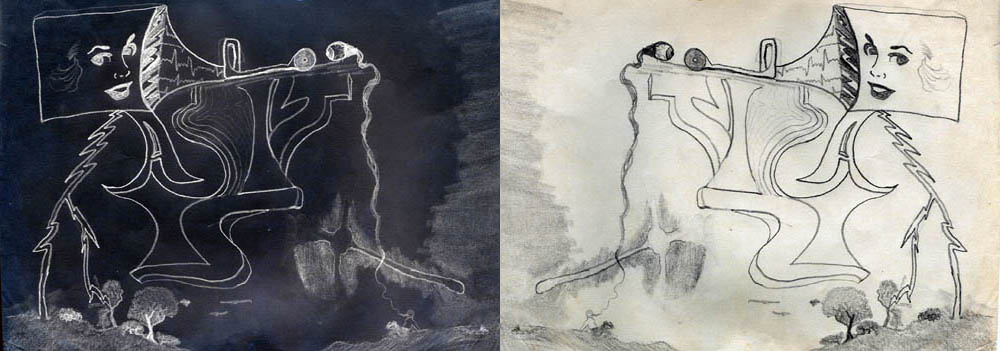
The best part of editing and posting my horror essays was digging through old boxes and finding the doodles and pictures my friends and I used to make for exactly those reasons. I put them up not because I thought they were particularly good but because they seemed to illustrate the impulses behind all of the rest of it. Barry's turned that impulse into her muse, and as different as they are, that's part of that essential quality Ludacris brings to the radio, that sense that he's just having fun in the margins.
Ludacris has built a whole career out of it because he does it so well that the margins have taken centerstage. And again, that's why I'm writing right now--because (thank you, Bruce) I learned more from the margins of my old spirals than I'd ever find in the notes.
Subscribe to:
Posts (Atom)