Friday, October 20, 2006

13 Days of Halloween, 2) Ghosts, Monsters and the Impulse to Do Horror


“We will each write a ghost story!”  --Lord Byron, June 1816

That challenge made by the great Romantic poet spawned three tales of the supernatural, yes, but not one story about ghosts in particular. Byron himself wrote an odd prose fragment about a mysterious companion who seemed to know the time and place of his death. His friend, Dr. John Polidori later turned it more explicitly into a vampire tale (in fact, a likely inspiration for Dracula). The most notable of the stories, Frankenstein, written by his friend Mary Godwin (eventually Shelley) helped create both the horror and science fiction genres, but it is only a ghost story in the most metaphorical sense.

What Byron called for didn’t need to have an actual ghost in it, but it did need some distinctive characteristics. When our childhood sleepover friends asked for a ghost story, that simply meant a scary story, probably one that plays on supernatural, irrational fears. Such ghost stories surely date back to the "invention" of fire, and most of us grew up hearing them and telling them one way or another. Though the ghost story, taken literally, doesn’t seem to have anything to do with monsters, the impulse does. The impulse toward horror depends on the notion of a monster, and Mary Shelley's Frankenstein all but defines that idea.

So where does this horror impulse come from? The history of horror, or the gothic, in literature, tells us a lot. Along with romance novels, the gothic novel formed one of the first genres of popular fiction writing, and the influential late 18th/early 19th century gothic novels by Horatio Walpole, Ann Radcliffe and Jane Austen--concerned with mysterious old castles, clanking chains and things that go bump in the night--allowed for a sort of reader-based rebellion against the era’s worship of reason. In this way, gothic tales served a distinct function as an inspiration to the Romantic writers, who would—as a group—ponder the limits of reason. The Romantics didn't reject reason, but their explorations were concerned as much with the irrational and subjective, those aspects of human experience that could not be easily quantified. The writings of Edgar Allan Poe and Nathaniel Hawthorne, in particular, dwell on the mistake of assuming reason can easily overcome these other aspects of what it means to be human. The gothic or the archetypal ghost story illustrates the danger.

Ghost stories almost always start the same way—with a new beginning. In movies, it’s that sequence of images of a family driving down a tree-lined lane, eyes searching beyond the trees up around the next curve for that house they’ve always dreamed of. Henry James’ A Turn of the Screw begins with a young governess eager to impress her new employer. Shirley Jackson’s The Haunting of Hill House begins with an exciting opportunity for a spinster who’s tired of being excess baggage in her sister’s family. Stephen King’s The Shining begins with an author taking the perfect winter job to overcome his writer’s block and heal his family. Whether it’s in the house on the moors with a new husband or simply a new subdivision, the characters in ghost stories have set their eyes on the future at the beginning of the story.

But the audience knows from the opening lilt of the storyteller’s voice that this dream of the future is doomed. Something is waiting for these characters, something supposedly dead, something out of the past. It may be an ex-wife who won’t stay in the ground, or the last governess, the last caretaker, or the Indian burial ground that lies under the new subdivision. Whatever it is, it’s a piece of the past that is unsettled, and it will bully our characters relentlessly until some kind of reckoning brings it satisfaction, even if the most likely results are only madness and death.

At the beginning of one of the more influential ghost stories of the past two decades, The Sixth Sense, Psychiatrist Malcolm Crowe finally receives the recognition he deserves at an awards ceremony. The suggestion is that he and his wife are turning over a new leaf, and the future looks bright for once; maybe it’s time for them to bring a child into their world.

But a piece of the past is waiting for them in the upstairs bathroom. In there, an old patient has stripped off his clothes and holds a gun to his head. And before he shoots himself, he tries to take the psychiatrist with him.

In that dynamic, we see the central fear of the gothic tale. When we finally have something to lose, when we want nothing more than to escape the bounds of the past, our ghosts rise up, and their demands can be merciless. As in the case of The Sixth Sense, or any of the tales I’ve listed before, our ghosts have the power to erase our future, and very often, they do; almost always, they forever alter it.

Ghosts alter the future because they offer a counterargument to the protagonists’ right to that future. They force the characters to confront whatever it is they are trying to deny, to gloss over, to ignore. They are that plagues us from childhood--the monster under the bed or lurking in the closet.


That sort of contradiction is always a part of the act of reaching for the gothic. Those of us who enjoy the mysterious, fantastic, weird and grotesque, those things that shake our sense of reality, do so in part because we are afraid of the unknown, sure. But there is something necessary and thrilling in confronting that fear. It makes us feel more fully alive. When we sit around the proverbial campfire and place a flashlight under our features and drop our voice to a menacing tone, we are sharing an enhanced sense of being human with others. Those who mock or condemn such behavior always ignore the healthy zeal of it.

And for our purposes here, we should never overlook the irony that motivates each of our various horrors. If the past is what scares us in a ghost story, it is essential to notice that the telling of the tale hands us ages old methods to reconnect with and stare down such fears.

One of the early definitions of the word “horror” describes it as a physical reaction to a fear, a shuddering. Sometimes we simply shiver at ghosts, but they can make us shudder, and that's the monstrous quality that truly defines the genre. We learn to fight through the shudders, so we can face our monsters down.

Pictures: Charles Ogle in Edison's 1910 Frankenstein and Mischa Barton in 1999's The Sixth Sense

Thursday, October 19, 2006

13 Days of Halloween, 1) Nana's Stories

Like most of us, I was born into a haunted house. For one thing, I was born amidst assassinations that shook my family caught up in the Civil Rights Movement. Medgar Evers was killed in his driveway four months before I was born. One month before I was born, a bomb in a Birmingham church killed four young women--Addie Mae Collins, Carol Denise McNair, Cynthia Diane Wesley and Carole Robertson--young women symbolic of the Movement youth transforming the country at the time. When I was one month old, the President’s assassination traumatized my family of Democrats, and a bust of JFK stood sentinel in my home from my earliest memories.

My older brother’s music filled the house, and an early memory of mine is listening, with my parents, to Dion’s “Abraham, Martin and John” on my brother’s stereo. By the time I was 7, the Beatles had broken up. Jimi Hendrix, Janis Joplin and Jim Morrison died within about a year of each other. By the time I could read my first picture book, the 1960s and my Kodachrome childhood guttered away.

We would have dealt in ghosts anyway. My mother’s side of the family was from Louisiana, and ghosts quilted the fabric of their stories. By the warm end table light in the little apartment where my grandmother lived alone, she told and retold these stories. As a young girl, her mother watched the former lady of her plantation home, long dead, transparently descending the stairs at dusk. As hard nosed and salt-of-the-earth a matriarch as you can imagine, my great grandmother Julia’s life was filled with such moments.

My grandmother’s little brother, whom she had watched over as a girl, had been killed in accelerated pilot training at Waco during World War II. Some snafu at the control tower led his plane into the air as another was landing. My grandmother said he held that plane where it descended like a leaf, so that the student might jump out. Neither one did. Later, at James’s funeral, my grandmother and mother both remembered that the coffin didn’t look long enough for his body. My seven-year-old mother felt his hand on her shoulder as she had this realization. For a while after her Uncle James died, my mother wouldn’t let anyone take James’s seat at the table.

Not long after that, my grandmother’s still young husband died. He’d had rheumatic fever as a child and never had a strong heart. Perhaps that was why he lived the active way he did. He was a forensic scientist who made trips to research malaria in southern Louisiana, and he was a saxophonist in a swing band and a choir director at their church in Shreveport. He loved entertainers, and my mother’s love of movies came out of his. He was friends with Jimmy Davis, who wrote “You Are My Sunshine” as well as Emmett Kelly and the puppeteer behind Kukla, Fran and Ollie. Grandma always joked that she never knew when he might bring circus people home to supper. After the picnicking and fireworks of July 4th, 1944, my grandfather woke up with a heart attack, and he was gone.

My mother, grandmother and great-grandmother all lived together after that. During my mother’s adolescence, my great grandmother came in the house from the front yard where she’d been consulting with a tree doctor about the sick elm in the middle of the yard.

“Mary,” she told my grandmother calmly, “I need to go to the hospital because James has come for me. It’s my time.”

“Oh mother,” I can hear the disgusted tone my grandmother used when she answered, “You’re fine.”

But she insisted, and my grandmother took her to the hospital, and she died within a couple of hours. My mother said she never saw anyone die so peacefully.

Odd as it may sound, some of my warmest early memories are these--sitting by my grandmother on the couch, prompting her to tell one story after another as the goosebumps stood up on my arms, tears came to my eyes and shadows in the room began to come alive and crawl.

Looking back now, I see that Grandmother’s ghost stories served several different purposes in my childhood. They conveyed a part of my heritage. An Ecuadoran student once told me that, to her, the Latin American brand of surrealism, magic realism, seemed like a way the authors showed respect for their elders and the stories they told, the way they told them. (For what it's worth Gabriel Garcia-Marquez said the same thing.) I understood exactly what she meant because I thought of my own grandmother. That’s an important connection because the Southern gothic and magic realism both make sense when looked at that way. The two traditions share a rebelliousness in their very desire to celebrate some of the most subjective and vulnerable aspects of who we are in the face of a changing world.

This theme is repeated again and again in horror—in tales of the vampire and the werewolf, even in the demon possession of The Exorcist, the arguably definitive modern horror story for the way it romanticizes denigrated past beliefs in its war with the conventional wisdom of the present. Even the awakening of those goosebumps, teary eyes and shadowy hallucinations serves as a sort of subjective communion with a way of thinking and feeling that is certainly primeval.

But the telling of those ghost stories also served another, less mystical but very likely more important, purpose. They brought my grandmother and I (along with my mother and my brother who also shared in this tradition) closer together. If one of the themes of horror is our fear of being alone (the bottom line in Frankenstein, for instance), it is important to see that the telling of the scary story is generally a collective experience. Even if one is simply reading a book (an act Stephen King has called a sort of mental telepathy), the writer and the reader are joined in the experience of confronting that which makes us feel like we are alone, together. This too is important. All of these concepts unite people despite their sense of isolation.

My grandmother lived most of her life alone, but she never seemed terribly lonely. I would guess a part of her strength came from her communion with her ghosts—none of the many people she lost in her life ever seemed far from her heart or mind. What she definitely passed on was a sense of connection. To this day, when my brother and I talk about our grandmother, we admit we still feel like she is right here with us. When we’ve each been at our lowest, we’ve gained a sense of unconditional love and strength from this sense of our grandmother’s presence. Whatever the spirit is, it finds sustenance in this sense of the otherworldly that comes through the ghost story. Though much of the value of understanding our monsters and horror has to do with what we fear, it is essential to keep in mind that the tale of what we fear offers a balm, a sense of communion with others, at the very least, in our shared fears.

(In the picture--Nana and her brothers; (l-r) Lewis, James and Francis)

Tuesday, October 17, 2006


Where the River Runs Black

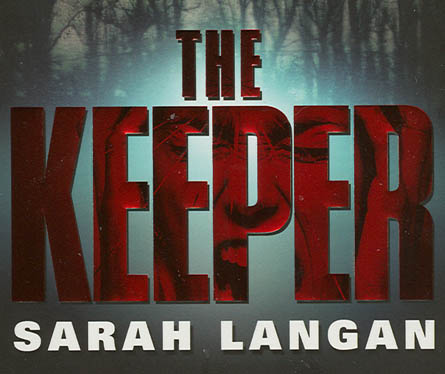
Finding Sarah Langan’s debut novel, The Keeper, at my corner grocery store has turned out to be a happy accident I can only compare to my “discovery” of Stephen King’s Salem’s Lot at a bus stop when I was 12 years old. And I feel doubly blessed right now to have read The Keeper on the heels of Bentley Little’s The Burning, two horror stories that also happen to be that most exquisite and rare find in the genre—distinctly American ghost stories.

Key to this is that this book begins with a quote from Bruce Springsteen’s “Independence Day” and manages to live up to that song’s haunted naturalism. The characters in this novel are real people living in the real America at the dawn of the 21st Century. Like so many Americans, these are characters who were born just a few decades ago into a society that promised, expected and planned for only the continued economic expansion that defined the American identity up to that point. And now those manufacturing jobs that served as the vehicle for that expansion have been automated away and become globally outsourced--leaving people who have given their lives to the company confused and betrayed and haunted by what never will be. In this case, Langan focuses on the small town of Bedford, Maine, and a paper mill, but whether we’re from my ex-oil town in Oklahoma or Whirlpool’s lame duck home in Benton Harbor, Michigan, we know the scenario all too well, and that makes this setting universal.

Even more important for satisfying fiction, particularly something as subjective as a ghost story, the focus on strong characters underscores the link between such political betrayals and our most personal secrets. Rich, vivid characters abound in this novel—each with their own heroic qualities and each with dreadful failures that they can’t ever quite shake. All of them are haunted by the Marley family, particularly Susan Marley, a beautiful, preternaturally gifted girl who tries to save her family from itself but winds up all but destroying it and taking the town along for good measure.

Though Langan shows herself to be a writer with an unflinching ability to savage her characters and fling her readers right along with them into the abyss, she has the absolutely necessary counterweight that makes King and only a handful of other writers, never mind writers of horror, so special. She knows people, and she knows them too well to sell false hope or, an even easier trap in our age, to fall into an easy cynicism. Where this book ultimately goes, no reader is likely to expect, but it’s a conclusion that comes from a knowing vision and trust in the integrity of these characters she has invested with so much life.

Ultimately, what I think I like best about great horror stories and ghost stories in particular is the way they counter our daily inoculations against reflection. The best ghost stories are, almost without exception, rooted in a reflective quiet. That’s that psychic space necessary for those things that have their reasons for not staying buried to come out and play, and Langan delivers a sprawling universe of such spaces. Even during some of the most apocalyptic horrors that threaten to run the book right off the rails in its final third, the prose has a Bradbury-like whisper to it that serves to keep the reader close.

In another song from the same album as “Independence Day,” Springsteen asks, “Is a dream a lie if it don’t come true, or is it something worse?” The Keeper gives us a good look at the maw of that “something worse.” It has to. Some things will never rest until they are dealt with head on.

Of course none of this would matter if Langan didn’t do it so well she’s only left me wanting more.

Now if I could just get over the genius of such a title for a debut—not only accurately describing the book but the woman who wrote it.

http://www.amazon.com/Keeper-Sarah-Langan/dp/006087290X/sr=1-1/qid=1161149105/ref=pd_bbs_1/102-3149483-3364948?ie=UTF8&s=books

Sunday, September 24, 2006


American Gothic

Ghost stories abound in our culture—good ones, too—though they rarely work in long form. I can’t stomach the cheese of The Ghost Whisperer, but I do overlook the convoluted and silly plots of The Medium for the show’s guaranteed chill-per-episode and its greatest asset, a family that doesn’t look like it knows it’s on TV. And while the charm of those ridiculous Brits on Most Haunted wears thin pretty quick, I do love that earnest Roto-Rooter gang on Ghost Hunters. Then there’s the countless ghost story anthologies rivaled only by true crime biographies and cold case investigations (both arguably forms of ghost stories) filling up basic cable stations like A&E, TLC, Discovery, the Travel Channel and Biography.

I’m sure many find this distressing evidence of how the horrors of real life are driving contemporary America into fantasyland. And while I can’t deny the truth in that, I think that’s superficial. I personally love it because I’m a fan of the ghost story aesthetically. But more importantly, I think it’s a trend worthy of, if not celebrating, at least understanding.

I think it’s as fundamental a core human impulse as writing a love song (psalm, sonnet, whatever), one of the expected responses to gathering around a fire at night, because it fills important needs—to find community in our needs, to face our fears and, at its best, to reckon with our past.

But—surprisingly enough—though what I think of as a certain ghost story template, the gothic plot, shapes much of our best fiction, very few ghost stories manage to work well over the course of either a full-length movie or a book. For that matter, very little gothic horror sustains itself that long. Go ahead, count up the horror books or movies that satisfy from beginning to end, and I would guess, unless you’re a Stephen King (who seems to have read and seen every one in existence), you’ll run out of titles before you run out of fingers.

Which is reason enough for me to want to celebrate Bentley Little’s new book, The Burning, probably available on your grocery store racks as I type. Since King talked him up in a recent Entertainment Weekly column, I’ve read two other Little books, and--while I appreciated their sure-footed prose, largely convincing characters, and most important, their genuinely chilling moments—this was the first where the surrealism did not gallop over some hill that made me sigh and contemplate (briefly) giving up and going home. It’s a tough job—weaving a believable universe out of nightmares and having it achieve the lift necessary for a satisfying novel—but I think it’s an important one in a society as hobbled by denial as ours, and Little does us a great service in the most modest way here.

Consider this novel’s scope, which it manages beautifully in less than 400 pages. It starts as a number of separate ghost stories, each intriguing in its own way—

A border patrol agent haunted by the migrants she thwarts on a daily basis, and the bodies of one such family she discovers who died in hiding, takes her son and flees the job and the bad marriage that goes with it only to find herself confronted by the ghosts of another mother and child in her new home.

A young Latina just starting her college career finds herself, first, bonding with her fellow classmates as they listen to disembodied voices coming out of closets and stoves in the middle of the night before the racial injustice behind the ghost story roars to life and turns against her.

Then there is the park ranger whose lonesome nights gradually fill up with fantasies of succubi that turn into the most unsettling kind of waking nightmares. For the longest time, he writes off his imaginative flights to his slim acquaintance with his Native American roots, but his dreams and reality become indistinguishable and he gets swept up in a tide approaching epic proportions.

Not so incidentally, all of these phantoms are Chinese, and The Burning works as well as it does because of the magic realism that weaves an American Indian sensibility, including hints of the Aztlan, with that of the Asian into a fabric that rounds out the more familiar tapestries of the American West.

What makes it all work is a magic to the pacing, something that reminds me of a series of personal experiences. Years ago, I was honored to spend a considerable amount of time working with several American Indian organizations, including AIM, on some local human rights issues. I distinctly remember the way our meetings would take shape. Indians of all ages and both genders would begin gathering at some prearranged start time, and people would talk and discuss what was going on in their lives and the children would play, sometimes for what seemed like hours. But at some particular point, when the light and the mood and the feel of the room was just right, the Elders would simply move to form a prayer circle, and the formal proceedings would begin. At that point, in the light of dusk or dawn, the air was undeniably charged with magic (whatever it is that magic may be).

Little’s The Burning has that sort of intuitive sense of pacing, and its final reckoning—focused around the forgotten persecution of the Chinese after the completion of the transcontinental railroad—is undeniably charged with magic in much the same way. And what the story (like almost all horror stories) lacks in real world solutions to the undead issues it raises, it finds a way to imply by insisting we can’t look forward without looking back, we can’t solve anything through vengeance alone and something even more important. The Burning, most importantly, asks us to free our imaginations to look past defeatism. It asks us to confront a familiar reality that’s nothing more than a systematic conspiracy of silence, consent and nurtured ignorance and see the possibilities of human will unfettered by such restraints.

It’s hard to ask much more of a tale of make believe; it’s also hard to imagine any more important reason for such tales to exist.

--------------------------------------------------

Speaking of people who deserve to have themselves shaken awake by things that go bump in the night, see the great SoundExchange article by Fred Wilhelms in the current Counterpunch. Chances are, you can even help with this reckoning--https://owa.jccc.edu/exchweb/bin/redir.asp?URL=http://www.counterpunch.org/wilhelms09232006.html