Monday, May 29, 2006


GREETINGS FROM NEW ORLEANS, LA.--

(Dave Marsh on Bruce Springsteen in New Orleans, from the May Rock & Rap Confidential)

In a time of warfare against a phantom enemy abroad and a war against the poor creating phantom citizens at home, up pops Bruce Springsteen with an album titled We Shall Overcome. He didn't have New Orleans in mind when he started making it in 1997, but both the music and the ways he's using it speak directly to the situation there today.

Deciding to start his current tour with the Seeger Sessions Band at the New Orleans Jazz and Heritage Festival on April 30 reflected Springsteen's sensitivity to the issues of poverty and racism and his ability to pick up on a catalytic opportunity. What Vietnam veterans were twenty years ago--a powerful symbol of the people the system tries to erase from view--New Orleans is today.

Discussion of Bruce's new album has focused on its subtitle, The Seeger Sessions, probably because people are puzzled by what it all means. The song selections don't seem nearly as political as their source, Pete Seeger. Yet four of the thirteen--"O Mary Don't You Weep," "Jacob's Ladder," "Eyes on the Prize" and "We Shall Overcome"--have at one time or another been used as "freedom songs." "Pay Me My Money Down" is that rare thing, a song that truly protests the situation it describes. "John Henry," "My Oklahoma Home," and "Mrs. McGrath" are explicitly about oppressed folk. That's almost two thirds of the thirteen song album.

One reason the album seems to avoid politics is "We Shall Overcome" itself. Springsteen's version downplays its spirit-rousing aspect; instead he sings it as one of his desperate love songs, even changing the chorus from "Deep in my heart" to "Darling, here in my heart." The result is a lovely ballad of two people against a hard world, and a violation of the collective spirit that the song stands for. He sings "Eyes on the Prize" in the same emotional mode, but it works a lot better.

The difference between the two is that on "Eyes on the Prize," Springsteen uses his band to build an arrangement that brings in voices and instruments to illustrate a community spirit taking shape out of the dark shadows inhabited by lonely isolated souls.

The music Springsteen makes with his biggest-ever band (thirteen members on the record, seventeen to twenty on stage) abandons much of what has defined his sound. In particular, the stiff rock beat has given way to syncopation. The instrumental focus is on the drums, with the melodic contributions emerging from fiddles and horns, rather than guitars and keyboards. The vocals, both his own and the multipart harmonies, are freer than anything he's recorded. After three albums of tragedy, the mood here swings toward joy. The album's tone is sometimes silly and once in a while fearful but it's never doomed.

Bruce wrote none of these songs yet We Shall Overcome is as personal as any of his records. For once on a studio recording, you can feel the unaffected pleasure he takes from making music, from working with other players and singers.

New Orleans right now is an eerie place, but not just because of the devastation. Abandoned cars and strewn rubble, even the scent of rot, are all over the place in Detroit and, for that matter, Asbury Park. What makes New Orleans different is that despite all the hype about reconstruction, nothing is being done. The housing projects are empty, looking more than ever like prisons. The upper Ninth Ward's population is decimated; the lower Ninth Ward's population is gone. But it's not just people that are missing. So are cranes, building equipment and construction site supplies, even as the courageous volunteers of Common Ground are hard at work in the Ninth, with a blue-roofed house in each part of the ward serving as a center for returning residents, for clean-up, and for visitors.

Musicians in particular are struggling right now, and one reason is that tourism--40 per cent of the pre-hurricane economy--has dwindled so badly. New Orleans does have a great indigenous music community, but the gigs that pay have long been played for outsiders.

The Jazz and Heritage Festival offers a lot of jobs for musicians but the most prominent and best-paying main stages, even the themed tents for jazz and gospel, mainly feature stars from far away. The splendid group of New Orleans icon Allen Toussaint appeared on the main stage right before Springsteen, but with Elvis Costello stepping in to sing several numbers.

Tourists will come to see, hear and eat the music and culture of New Orleans and the Louisiana swamplands. But to get enough of them to fill the huge Fairgrounds racetrack and gain national attention, not to mention lucrative corporate sponsorship, the promoters of Jazzfest need artists like Bob Dylan, Dave Matthews and Springsteen. (The festival is run by a nonprofit corporation, which doesn't mean a lot of money isn't being made.) This aspect of New Orleans may thrive--but it's hard to see how it will do much to change conditions there. It's equally hard to see how presenting a festival with a more local focus would help rebuild the city, either.

Music can do a lot of other things though. Above all, it can provide inspiration and foster connection. Springsteen's always been a man on a mission when it came to those to jobs, and changing bands and singing traditional songs didn't affect that. If anything, this is the strongest outreach he's made in years, stronger than The Rising because he's playing a species of dance music, designed to activate the ass and the mind. And in New Orleans, as backstreets.com noted, "Bruce wasn't preaching to the choir for the first time in a long time."

Springsteen was not only starting a new tour with a new band and new material, but he's Bruce Springsteen, the rock star who is supposed to rise to occasions. He needed a set that lived up to the drama of closing the first big event in New Orleans since the flood.

His big brass section added Crescent City flavor, and drummer Larry Eagle's fat, syncopated beats kept the cadence right. And Springsteen kept things focused. "Oh Mary Don't You Weep," the opening song, ends with: "God gave Noah the rainbow sign / No more water but fire next time." "Eyes on the Prize" with its recurrent "Hold on" also invoked an embattled spirit: "The only thing that we did right was the day we started to fight." But the show found its legs and definition with a sequence that began with the refugee anthem, "My Oklahoma Home Blowed Away," and ran through the Irish antiwar ballad "Mrs. McGrath" before peaking with the Depression-era anthem, "How Can A Poor Man Stand Such Times and Live."

Springsteen introduced it with a statement about how shocked, furious and ashamed he felt about what he'd seen since hitting town, then dedicated his rewritten version--"Them that's got, got out of town / And them that's not got left to drown"--to "President Bystander." After that, he had the crowd. With his somber "We Shall Overcome," he gripped them tighter. By the end of that one, even violinist Soozie Tyrell turned to wipe back a tear. That wasn't the climax though. For the first encore Springsteen came out and began to sing "My City of Ruins." As he described that "blood red circle," then pleaded for us to "rise up," tens of thousands of fists raised in the air. Thousands of tears formed a new salty flood.

The concluding "When the Saints Go Marching In," also slowed down considerably, should have been anticlimactic. But Springsteen unearthed verses rarely sung, beginning the song with "We are traveling in the footsteps of those who've gone before." In the ruins of America's oldest big city, those words resonated like a midnight echo in an abandoned housing project.

But I left contemplating the last verse, sung by this tour's Bruce sidekick, Marc Anthony Johnson of Chocolate Genius. "Some say this world of trouble is the only one we need / But I'm waiting for that moment when the new world is revealed."

Those lines took my understanding of one of Springsteen's best lines--"Don't waste your time waiting" from "Badlands"--and turned it around. And that made me consider what it would mean to reveal a new world in this life. We need patience to wait for the new world to reveal itself, that's true. But we mustn't waste that time merely waiting, because only struggle and refusal to surrender can bring that new world forth.

Music can't change the world. But sometimes, it delivers some pretty great marching orders.-D.M.

www.rockrap.com

Friday, May 05, 2006

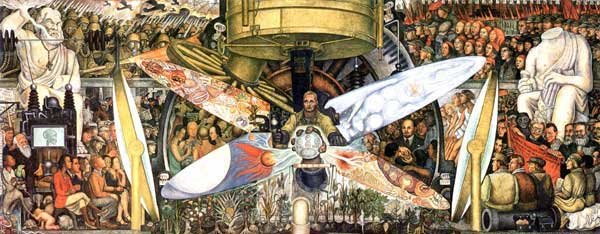
www.diegorivera.com

America Para Todos

A few years ago, a friend of mine--Creek Indian, from Oklahoma--was boarding a Kansas City bus when the brown-skinned bus driver half-joked, "You Indians sure look a lot like Mexicans."
My friend snapped back, "Nah, you Mexicans just look like Indians."

Of course, the joke was the thing not said--how political borders divide native Americans to the point where ethnic similarity is a surprise. Obviously the difference in red and brown is not some biological equation that comes out of miscegenation between Spaniards and Indians (certain kinds of facial hair maybe), but it is division born out of the rise of nation states, and with multinational business driving the World Trade Organization and World Bank to solutions such as NAFTA, the border that divides the indigenous people of North America above and below the Rio Grande is a border that no longer exists for the CEO. In other words, these borders only blind average Americans to our common ground.

As if there's an American identity without our brown brothers and sisters. Let's assume we can forget how Mexican migrant farmworkers played a fundamental role in establishing our agricultural economy or how the "Bracero" program--exploiting migrant farmworkers when we needed them in 1942--helped us to win World War II and ensure our role as a superpower. Even if we can forget how brown Americans built this country, how can we imagine an American culture without its Latin influences?

Of course, many never even contemplate the way our culture is fundamentally shaped by the influence of West Africans. Black Americans just came here with the Europeans in the 1500s and built the country. From our uniquely American accents, grammar and vocabulary to our popular culture, no aspect of our culture has ever developed independent of this influence. And the same should really be said of our Latin American influences, in part because they overlap so much.

If we talk music, that truth is plain, starting with the fact that it's nearly impossible and probably meaningless to try to separate the West African and Latin American influences on the musics of the diaspora, the path of the slave trade through Latin America. From rhumba bands to the Bo Diddley beat, "Louie Louie" to "96 Tears" to "Land of a 1000 Dances," hip hop to reggaeton--Latin American polyrhythms have shaped our popular culture.

Even those aspects of our music most stereotyped as ethnocentric--the "western" ranchera sounds in country and western, or the Spanish style Nudie suits or cowboy hats and boots--all spring from Latin American tradition. And out of this exchange, there are those fascinating dialogues between Germanic and Eastern European farmers and Latin Americans that create the common ground of polka and norteno, with Tex Mex and Southern R&B talking back and forth between accordian and Farfisa and Hammond B3 and whatever descendent of Casio we've graduated to now.

And then, of course, there's the core symbol of the democratization of American popular music, that instrument just about everyone could order from Sears on the cheap and play in their living rooms, bedrooms or on their front porches. That Spanish string instrument that embodies virtually all of the big gestures in rock and roll--the gunslinger's weapon, the axe, the iconic tool of rock bravado--la guitarra, the Guitar. Take away the guitar, do we even have what we think of as the rock revolution; take away the Latin influence, is rock even possible?

After all it's not the individual parts that matter so much as the mix that can't be disentangled. It's fairly easy to see how Latin American music helped to shape both California rock and modern country, for instance, just as it's easy to see the role it played in the attitude, identity and feel of gangsta rap and its inheritor, crunk. We can say that Roy Orbison sang like some lost opera star because he grew up listening to ranchera music in Texas, and that would be true. But there's also what Roy Orbison sang about--lost love and loneliness, sure, but also, over and over and over again, of dreams. Are there Latin American roots not only when Bruce Springsteen trots out "Rosalita" but when he evokes Roy Orbison for the dreams of "Thunder Road" or when he closed his last tour singing Suicide's "Dream Baby Dream" like a prayer for the country? Yes. Of course.

The Latin fabric that is essential to the American identity isn't overlooked because it's minor or anything close to invisible. It's overlooked for more insidious reasons, most fundamental being that if we confront our Latin heritage, then we may have to come to grips with how such accepted notions as borders actually serve to keep average people fighting one another instead of joining voices in unity.

As should be clear, our cultural intuition is already far ahead of the curve. American music is Latin American music, and I don't have to cite Sean Paul, Rihanna, Daddy Yankee, Akon, Frankie J or Shakira at the top of the charts to prove that. And when the nation's leaders don't seem to have any concept of what it means to tell the truth, maybe we shouldn't be too quick to dismiss the political dimensions of Wyclef Jean and Shakira singing, "Hips Don't Lie." Amen to that.

So when Prince winds up his new search for grace, 3121, an album laced with Spanish themes, it shouldn't be surprising that he finds communal salvation with Sheila Escovedo providing enough timbales to make Tito Puente proud. This is music for an America without borders, where all the strains of our peoples' culture work together. The result? Go play that jam and tell me it doesn't sound like liberation.

--Cinco de Mayo 2006


Wednesday, April 26, 2006

Bruce Springsteen, Pete Seeger and The Circles Where We Belong

I don’t even quite remember the context, although I’m hoping that writing about it will help me get to it, but one of the last things Dave Marsh said to Bruce Springsteen Sunday in the Sirius broadcast of their Seeger Sessions interview was, “That’s the circle on the beach where you belong, Bruce,” and that rang out to me, brought me full circle in a sense.

Ever since I started puzzling over The Rising's “My City in Ruins” and that “blood red circle” on the ground Bruce describes, I’ve felt a piece of Bruce’s surrealism I couldn’t quite fill in. Admittedly, maybe I’m not supposed to, maybe he can’t. That’s one of the most redemptive qualities in his music, the counterbalance to the thoughtful meticulousness in his approach. Bruce’s music is always at its best in its open-endedness, that surrealism that made those first couple of albums so wild-eyed with possibility, that sense that no matter how much Bruce planned and strategized and tactically orchestrated what he was up to, intuition filled in the gaps. And that’s one reason I so loved Human Touch while it seemed to leave so many Springsteen fans scratching their heads—the gypsy sojourner burst out of the American icon, and it began to reconcile or weave together all of the threads of Bruce’s career to date, starting with the defiant loser I first responded to who was now all but obscured by the troubled winner.

Daniel Woolf, in his Counterpunch essay about the album Devils and Dust helped me figure out something about that circle when he focused on the circle on the ground drawn by the boxer in “The Hitter,” that circle where the guy fought, the only thing he knew how to do, which had come to isolate him, in this case outside his wary mother’s door.

But what Dave was referring back to at the end of the interview was a circle Bruce described much earlier in the interview. Bruce told a story that filled in a missing piece of his own early history about his cousin, Frank, who, in the folk music days before the Beatles, would sit on the beach with a bunch of friends and sing folk songs with a bunch of friends. Bruce would listen to them play and watch the pretty girls in their swimsuits listening, and he began to long to play the guitar just well enough to keep up with the others, to strum along and be a part of that circle. I believe Bruce said that his cousin Frank showed him the E minor chord on the guitar (the chord most of us fall in love with first because it is so simple and so haunting), and Bruce started off playing the guitar by alternating between that and the A chord right next to it. Most guitarists must know exactly what he’s talking about because I certainly do—my very first songs were built around E minor, A and D--such simple chords but so full of mystery when played together (after all, throw in a G and you’ve got “House of the Rising Sun”).

This talk of circles and Bruce’s need to fit into one got me thinking about my friend Herpreet Kaur Grewal, whom I met at the Springsteen conference last September. She read a paper trying to answer the question of just what so intimately connects a 26- year-old Sikh Londoner to a 55-year-old American male from New Jersey, and she came up with their common search for a home that doesn’t quite exist in any concrete way in the world but that does exist in the music. She put up a slide of Bruce from Nebraska, where he is standing in a doorway, outside looking in, and compared it to John Wayne in The Searchers, at the end of the movie, walking away from the wedding party, the community he has helped to restore although he is inevitably shut out of its circle.

Herpreet pointed out to me that that was the theme of Martin Scorsese’s Bob Dylan documentary No Direction Home as well, and I thought of that again when Bruce said in the Marsh interview that Bob Dylan was “the father of my country.” Dave responded with “the old weird America?” And Bruce said, “yeah, the one I recognize.”

When my friends from New Jersey talk about recognizing the sights, sounds, the unspoken impressions of their home that they recognize in Bruce’s music, I almost always want to chime in that I know just what they mean, though I hadn’t visited any of those places until about 8 years go. What I mean is that’s what I always heard in Bruce’s music—the world I know, the details of the place where I grew up, the main drags and winding section roads where I drove my car in endless circles listening to an 8 track of Darkness on the Edge of Town. Just as I knew that’s what my friend Steve Perry was talking about when he reviewed Steve Earle’s first album and talked about his own Iowa hometown in “Someday,” and something tells me Steve P. in the upper Midwest and Steve E. in San Antonio and myself in an Oklahoma oil town could all hear ourselves together, on our own hometown streets, prowling like caged animals in “Something in the Night.”

I first understood how the Seeger Sessions were bringing me home when I heard “My Oklahoma Home." That song’s most Guthrie-ish comic absurdities are also some of its most painfully real moments. Any Oklahoman knows “as I bent to kiss her, she was picked up by a twister” is hardly hyberbole compared to the real horror stories associated with tornadoes—one of the most absurd weather events imaginable. I can never forget one story where a young girl hiding from a tornado under a bridge reached out to take a woman’s hand and watched that woman fly backwards into the air up and away from her, or so many other stories of children taken from their parents’ arms and, sometimes, found unharmed, swaddled in debris 100 yards away.

Anyway, "My Oklahoma Home" moved me to tears--more than that. In general, I have such a hard time crying at life. The terrible things that have happened in my life have often sent me into shock, but just as often the tears are hard to come by, and I feel like I need them often when I can’t summon them. Music can make me cry when nothing else will, and when music moves me to tears, not just to wet eyes but to want to break out into a sore throat makin’, snot pouring bawl, well, I take note.

“My Oklahoma Home” did that, well before the New Orleans brass kicks in and makes it clear that this is the Katrina survivors’ story just as well as it’s the story of the Dust Bowl Okies, and that of the Latin American immigrants and their families and friends and supporters marching to hold on to the circles they’ve carved out in the U.S., and that of so many I love displaced and lost in the oil industry downsizing that started in the 80s and therefore my story, Bruce’s story and the story of the American people as a whole at one time or another--certainly in the alienated, broken times we are living in and the days ahead of us.

And on Dave Marsh's Sirius show, Kick Out the Jams, when I heard the song’s writer, Sis Cunningham, sing the song, I felt those tears well again, particularly when I heard that odd pronunciation of Cimmarron (Simarown) that both she and Bruce and presumably Okies of another time share. When I went to school in Stillwater, Oklahoma, the Cimmarron River and the red dirt of central Oklahoma became the landmarks of my home, and finding community there in college--around music, around human rights struggle, around our need to carve out a circle of our own—I found the first community I ever really felt a part of. And I think that’s exactly why that one word hit so deep. My red dirt home has blown away. My first home being a college home, my brothers and sisters in that community have scattered in every direction imaginable, but they’re also always with me, central to who I am. Like that guy in the song, I won’t say I’m never homesick, but the only place my Oklahoma home exists is in the sky, and I hear so many of my loved one’s voices there—people who I may never talk to again in reality, but we’re always talkin’ anyway.

And that’s another way this all comes full circle because that guy in the song is any character on The Rising, anyone in America who lost the home (the country?) they once lived in (and in many cases, literally the people they once loved) on 9/11. We all have 9/11, and we all have our own 9/11s, and we all are trying to learn how to live brokenhearted, and we are all trying to grow up to become someone who can dream again.

Which is where this thing I’m trying to write really comes full circle. The last thing I wrote of any length to a music writer's listserve I am on was about my disappointment over hearing Bruce’s strangely muffled “We Shall Overcome.” I wanted to hear Dave's Sirius interview with Bruce, in part, to hear how Bruce explained it. He didn’t, but I think he answered all my immediate questions in various other ways, particularly in his description of “Keep Your Eyes on the Prize,” a song he describes, as he describes all the freedom songs on the record, as “surreptitious.” The voice he found for those songs is the voice of someone who’s heard of a secret chance and is talking conspiratorially to someone else he can trust about that possibility. Explicitly, to me, that’s the voice of someone who has heard he might just have a shot at dreaming again, of rolling the dice with some hope again, and he’s afraid to say it too loud because it might jinx the whole thing or land him in prison. This reminds me of a similar insight Daniel had into Devil’s and Dust which helped to unlock that album for me, and I get it emotionally, and it seems very much like America today to me.

The other day at work, one of my co-workers was questioning why one of us was so quiet about her activism, and I had this outburst, saying I was just like that, that most people at work had no idea what I was up to because of the climate and the culture and the way I feel I need to choose my battles carefully. In the day-to-day world most of us live in, I think dreams of possibility can be hard to voice in anything louder than a whisper.
One of the most interesting moments in Dave’s interview is when he points out that part of what’s so surprising about The Seeger Sessions is that it comes after three albums that have been tragedies. Although the singer’s revved to talk—he talks more animatedly and uninhibitedly in these interviews with Dave than I’ve ever heard him before, and it suits him well—Bruce pauses, says “I never thought about it that way,” and sounds like he’s dying to argue with that but wonders if it’s not true. It’s funny because that was my first response to Dave saying that as well. In particular, I didn’t want to think of The Rising as a tragedy because of its defiant hope, particularly in the title track and “My City in Ruins.”

But the classical definition of a tragedy is that the order at the end is only partially restored with significant pieces missing, and that guy in The Rising seems to be dead, and the one in “My City in Ruins” is calling, but he’s really dreaming of a response.

So, in this context, the couple whispering over their own chances in this new “We Shall Overcome” makes a little more sense. I wrote this on Sunday, after the interview, and I decided not to rush out online and play it again. That being the most disappointing thing I’d heard off of the new album, I decided to wait until today, the album fresh from the store, to hear it all as a whole, my Tuesday ritual whenever he has a new album. I wanted to hear that song in its context. Bruce is such a dramatist that the most fragile pieces of his work tend to work best when they are in place as movements in a larger whole, scenes in a longer movie. And I do experience him most fully as both an album artist and as a concert artist, weaving all of these varied pieces of what he does into a larger whole, ultimately his story that, for many reasons cited above and more, feels like our own.

I want to just flat out say it is our own, at least those of us lucky enough to hear it. That’s what I think Bruce has done that’s been most important, and I think it’s the thing that really links him to Pete Seeger. As incredibly talented as Bruce is, he always made music that said to me, “you can do this.” And, ultimately not proving to be much of a musician myself, I knew that the music had to mean more than this—it’s not that you can make music in just this way, but you can make your own music in the life you lead that keeps this vision of the promised land alive and the life we lead in trying to get there… worthwhile.

I can’t seem to write anything anymore without referring to “Sonny’s Blues,” so why fight the temptation… Probably my favorite line because it is most haunting and mysterious (like the key to the universe) is that line near the end—“Freedom lurked around us and I understood, at last, that he could help us to be free if we would listen, that he would never be free until we did.” Similarly, in both the metaphor’s mystery and its strong sense of direction, I think both Bruce and Pete have left that circle on the beach wide open--so the rest of us can find our place in the sand, knowing full well that they don’t really have a circle at all until we do.

Danny

Saturday, April 22, 2006


The Roof Is On Fire

Maybe music isn’t inherently revolutionary, but you can’t tell it from listening to Kumbia Kings Live! I’ve long been a fan of the Kings seemingly effortless blend of the best qualities of today’s hit rap, r&b, reggaeton, norteno and tejano. It’s hard to imagine a band more alive, awake and responsive to the music of everyday Americans—brown being the color that just might hold this country together or transform it into something approaching its promise.

When people talk revolutionary music, they always go to lyrics, and, frankly, that’s very rarely where I hear the demand for fundamental change most clearly expressed. I hear it more than anywhere else in the force of the rhythms and the power of Chris Perez’s electric guitar (though, admittedly, that guitar rings out most clearly on the solidarity anthems “Mi Gente” and the cover of Maldita Vecindad’s “Pachuco"). And I hear it in the voices of a hundred thousand Monterrey, Mexico fans singing along with this group’s gorgeous balladry, making a sound so exultant it seems more threatening to the dog-eat-dog world outside of the arena than any actual protest might be.

And that’s just the thing made even more vivid by the accompanying DVD—the power of the joy shared by this band and these fans. This fifteen-piece crew has a backline that lays down relentless fiery rhythms and a team of frontmen who can move together like the Temptations one moment, break and pop & lock the next and fast rhyme hard enough to make Twista sweat. The showmanship clearly draws people of all ages and both genders, but no one steals the show quite like the countless teenage girls who sing along to every word and move like they’ve never felt how good it is to be alive in quite this way before.... And the revolutionary heart of music, that promise that each individual life is worth a world that acknowledges its worth, couldn’t be any more apparent than when this crowd sings “No Tengo Dinero” or “Fuego, fuego/The roof is on fire/We don’t need no water/let the motherfucker burn!”

If nothing else, the fact that the Kumbia Kings are still not a household name in white America is one reason the system is begging to be overturned.
****
Of course, another reason is the lack of universal health care. And what’s wrong with this system is pretty clearly expressed by the fact that musicians have to constantly throw benefits (at the tune of about a 1000 a week in the U.S.) to pay people’s medical bills. Still, that’s also one of the things so beautiful about music.

Just last week, Kansas City's premier salsa band Son Venezuela and their fans came together to raise money for a family member of a dear friend. Their statement:
Andres Fustini, a fixture of cultural exchange within the Latin American community in Kansas City, suffered a tragic stroke that left him a quadriplegic, and devastated his family.
The Fustinis have sold everything they have to try to keep up with mounting medical expenses, but it's not enough.
As members of this community, and of the greater community of Kansas City, friends of the family organized a benefit party to raise funds for this family in such great need.
Pictures from the event are below, along with a link to Son Venezuela’s web page--
http://staff.jccc.net/mcgarvey/fustini_benefit_dance.htm

http://www.fustinifundraiser.com/